Showing posts with label 19th Century. Show all posts

Saturday, 19 July 2014

Historical Clothing for Sitters at the ROM's New Fashion Exhibition

Recently, the Patricia Harris Gallery of Textiles & Costume at the Royal Ontario Museum had been closed in preparation for a new exhibition. As a volunteer who is personally a bit more on the introverted side, I'm always aware of what goes on there, seeing as it is one of the quietest and most tucked-away areas of the museum. Well, as of June 21, it's re-opened with not one, but TWO new exhibitions. The first, Cairo Under Wraps: Early Islamic Textiles features some fascinating textiles and clothing from the 7th to 14th centuries. However, this post is about the second new exhibition that's opened up: Fashion Follows Form: Designs for Sitting.

The exhibition focuses on the work of Canadian fashion designer Izzy Camilleri, especially her line IZAdaptive, which was developed specifically for the convenience of wearers in wheelchairs. To do this, she drew off historical examples of clothing that were also designed with sitting in mind: riding habits, breeches/trousers, bustles, etc.

Now, I do not yet have images of Camilleri's own designs and pieces just yet: history nerd that I am, my first visit to the exhibition focused primarily on her historical sources of inspiration. So, here are some of the highlights from that particular subset.


Here, we have a 1770s English riding habit that was designed for a woman to wear sidesaddle. You can see that it was made in multiple pieces that simulated the coats and waistcoats worn by men. However, shorter's women's jackets were worn during the 18th century as well, so it's not simply about emulating menswear by any means.


Speaking of 18th century menswear, this was also a piece that was displayed as part of the exhibition. It is also English, and dates back to 1750. What served as Camilleri's inspiration here were the breeches. 18th century breeches were tailored very closely to the wearer's thigh. But can you imagine wearing skintight breeches made out of silk, wool, cotton, or linen? Those fabrics were less forgiving and elastic than today's synthetic materials, so trying to move in something that was too tight would be a wardrobe malfunction waiting to happen. So, in order to give a reasonable amount of manoeuvrability, 18th century breeches were also cut to be quite baggy in the rear.


You can really see the bulk in the derrière on this example: a pair of American breeches made between 1775 and 1799. So what's an elegant 18th century gentleman to do? Well, the long, flared skirts of the coat would have covered up this unsightly concession to practicality, thus enabling the wearer to keep up the well-tailored silhouette favoured at the time.

In fact, the coat's skirts also served another purpose re: sitting. There are slits on the side and back of the coat that allowed the skirts to be spread outwards while the wearer was seated (ex. in a chair or on horseback). This meant that sitting down did not entail sitting on a bunched up mass of fabric: again, a design created for comfort.

(On a side note: those slits also made it easier for the 18th century gentleman to wear his sword, which was a key part of formal court dress at the time!)

Now, moving on to one of the classic moments in 19th century women's fashions: the bustle.


This 1880s bustle was made in Canada, and is an example of the underpinnings worn by women in the latter decades of the 19th century. The bustle created a silhouette that emphasized the rear: instead of a bell-shaped skirt, the fabric would be swept backwards to drape down to the floor. Such a look, one would imagine, would make sitting difficult. But in this case, the bustle's structure made things easier: it is made in the style of a crinoline: rather than a solid piece, there are a series of metal pieces connected by strips of fabric. This meant that the bustle had sufficient give and freedom of movement to make it capable of bending when its wearer sat down.


Following along with the bustle silhouette, jackets like this 1887 dolman (of either English or American origin) were designed to flare outwards in the rear as well. Pretty, eh?

So where am I going with all of this? Namely that fashions for sitting are not a recent concession for accessibility or ergonomic purposes. There are plenty of historical instances when people have done the same, seeking to combine fashion with considerations of practicality. Yes, I know that from a 21st century perspective, the vast majority of 18th and 19th century fashions would not seem practical - but these pieces, in the eyes of their original wearers, were.

Image Credits

All photographs shown here were taken by Kita Inoru

Sunday, 15 June 2014

Catch-22s in First Nations Depictions: The "Noble Savage" in History

This coming Saturday, June 21, 2014, is not just the Summer Solstice here in Canada. It is also called National Aboriginal Day, and is a time set aside to honour and acknowledge Canada's various indigenous peoples: the First Nations, the Inuit, and the Métis. So in this week leading up to National Aboriginal Day, I will be writing up a series of blog posts pertaining to the First Nations peoples in Canada: I've got four posts planned so far, but may do more if circumstances and inspiration permit.

There are a lot of things I can choose to focus on for this series, but I have settled on one broader theme: "Catch-22s in First Nations Depictions" refers to the times and contexts in which simplistic means of interacting with the First Nations peoples and their cultures simply fall apart. They are about the stereotypes and common images that have become predominant in how Canadians have come to perceive our First Nations - some more successfully and appropriately so than others.

Before I begin, a quick disclaimer: I, Kita Inoru, am NOT a person of First Nations descent. What this means is that the perspective and the opinions that I express here are solely my own. If there is anyone here who is of First Nations descent and/or is directly affected by the issues discussed in this series, please feel free to shed further light on them in the Comments, and please be patient with me in regards to any errors I might make. Thanks!

My discussion, then, begins with what is probably among the oldest and most iconic images that we have of the First Nations peoples in Canada: the Noble Savage.

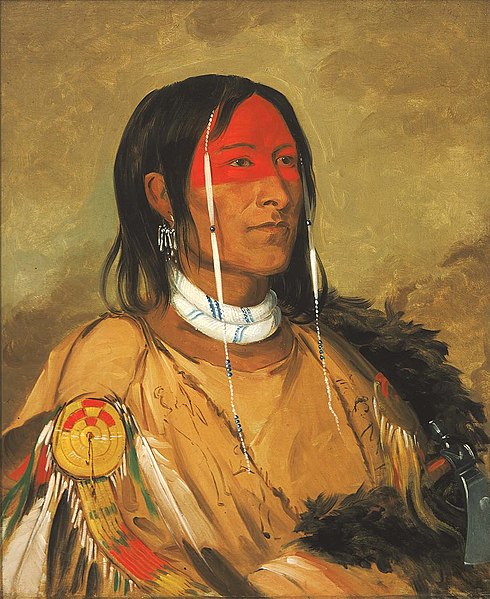
"Eeh-tow-wées-ka-zeet, He Who Has Eyes Behind Him (also known as Broken Arm), a Foremost Brave" by George Catlin (1832)
The concept of the Noble Savage goes back hundreds of years. Arguably going back even to the Roman historian Tacitus and his description of the Germanic tribes the Romans encountered in battle, the first known use of the actual phrase in English dates from 1672 in John Dryden's The Conquest of Granada. However, the concept - if not the phrasing - is most commonly associated with Jean-Jacques Rousseau; in his A Discourse on Inequality, he argues that mankind began in a primitive State of Nature that, while lacking government and technology, was far happier than the class system that evolved out of "civilization". For Rousseau, one of the main objects of his focus was the First Nations in North America, who he saw as having persisted in the State of Nature that he saw as the ideal for humankind.

For the most part, the Noble Savage is simply that: a "Savage" who exhibits "Noble" characteristics. However, I find that that does not show the sheer complexity in terms of how the First Nations have been perceived either historically or in the present day. The way, then, that I would like to examine this concept is to break it down into two main groups of characteristics: those that are "Noble", and those that are "Savage".

Detail showing an Iroquoian warrior in "The Death of General Wolfe" by Benjamin West (1770). This is now one of the most iconic representations of the Noble Savage in 18th century artwork.
In the 18th and 19th centuries, in artwork depicting the First Nations peoples, there is a certain nobility infused into the image. The Native is shown in a calm, almost stoic, pose: quietly contemplating either the surrounding events in the painting (as seen in Benjamin West's "The Death of General Wolfe") or the viewer (as seen in George Catlin's many portraits of First Nations people). He or she is usually shown wearing some sort of traditional dress or regalia: feathers, buckskins, paint, etc. Sometimes, the image is one of the Natives taking part in a traditional, pre-European-contact, way of life: hunting or fishing are common depictions. All in all, the image is one that shows the First Nations as people at one with the wilderness: content to stay that way for all eternity, but now having to face the encroaching European settlers that spell their inevitable downfall. The First Nations as "Noble" become romanticized tragic heroes for Europeans to contemplate, but not to help.

Conversely, and concurrently, there is the image of the "Savage". This is the concept of the First Nations as hardened warriors who raid European settlements, scalping, enslaving, and killing the inhabitants. It is the image that looms large in the French Jesuits missionaries' descriptions of the Haudenosaunee (Iroquois) in their wars with the neighbouring Wendat (Huron) and Algonquian peoples; in the many stories of "Indian captives" that sprung up during the Seven Years War (aka the French and Indian War, for those in the States); in the whispered tales of dread at the discovery that the British were enlisting the Iroquois on their side during the American Revolutionary War.

"Incident in Cherry Valley - Fate of Jane Wells" by Alonzo Chappel (1828-1887), engraved by Thomas Phillibrown (1856). Jane Wells is pleading for her life, and a man attempts to protect her from an Indian who is about to kill her. House behind them is being burned by Loyalists and Indians led by Major Walter Butler and Mohawk Chief Joseph Brant, Cherry Valley, New York.
For all that the First Nations were romanticized in history, the underlying fear and dread that European settlers in North America had of them never vanished entirely. Not only was there a conception that the First Nations were dangerously violent and unreceptive to "proper" rules of warfare, but the fact that many had societies structured entirely differently from the familiar Judeo-Christian model convinced many settlers that they were simply not to be trusted. In the case of Canada in particular, the Algonquian peoples were seen as lazy for their hunter-gatherer, semi-nomadic lifestyle (i.e. they were lazy because they did not farm the land and make full use of it as per God's command); inversely the Iroquoian peoples, who did til the land, were seen as barbaric in their torture of war captives, and backward in their matriarchal approach to leadership (i.e. the fact that women were often in charge meant both that they were insubordinate and that the men were weak).

It is the intersecting of the two sides of the coin - the "Noble" and the "Savage" - that reveals the unstable ground upon which European settlers in North America found themselves in trying to define the First Nations around and among them. However, regardless of whether the "Noble" or the "Savage" predominated in popular perception, the conclusion was the same. The settlers believed that the First Nations could not run the show for themselves anymore, but must be guided into a "better" way of life: either more "advanced" (in the case of the "Noble"), or more "civilized/moral" (in the case of the "Savage").

That may be the history, but the story itself does not end here. Stay tuned for the next installment of "Catch-22s in First Nations Depictions" to see how the duality of the "Noble Savage" has become manifest in today's societal views of the First Nations in Canada.

Sources

Bickham, Troy. Savages within the Empire: Representations of American Indians in Eighteenth-Century Britain. Oxford: Oxford University Press, 2006. Print.

Godesky, John. "'The Savages are Truly Noble'". The Anthropik Network, 10 May 2007. Web. 15 June 2014.

Rousseau, Jean-Jacques. A Discourse on Inequality. Trans. Maurice Cranston. London: Penguin Books Ltd, 1984. Print.

Image Credits

All historical artworks (c) Their original creators as indicated in the captions, found via Wikimedia Commons

Sunday, 18 May 2014

Victoria Day and La Journée Nationale des Patriotes: One Holiday, Two Sides of History

May Long Weekend, May Run, May Two-Four...whatever you decide to call it, Monday, May 19, 2014, is Victoria Day in Canada. For many, it's simply a time for general spring-related festivities: going up to the cottage for the first time in the season, gardening, barbeques, and fireworks.

But there's far more to the holiday than that if we were to look into its history. Victoria Day was first declared as a holiday in 1845, and was celebrated on Queen Victoria's actual birthday - May 24.


Statue of Queen Victoria outside the British Columbia Parliament Buildings in Victoria, B.C.
Changed to the first Monday prior to May 25 in any given year in 1953, it now also serves as the day on which the ruling British monarch's birthday is celebrated, regardless of whether he or she was actually born then. Queen Elizabeth II, for example, was actually born on April 21, but her "official" birthday is still marked on Victoria Day in Canada. Because of this, where there are at least two flagpoles, federal buildings, airports, and military bases will fly both the Canadian flag and the Union Jack on that day.

(Note: I actually have yet to see this arrangement in person; if anyone has, and has photos, please let me know in a comment - thanks!)

Therefore, it is fitting - and likely no coincidence - that this year's Victoria Day will coincide with a royal visit as the Prince of Wales and the Duchess of Cornwall take part in a tour of the Maritimes and Manitoba from May 18 through to May 21, 2014. For those in Canada who like to uphold its British heritage and the historical ties with the British monarchy, there is no better way of celebrating Victoria Day.

However, there is, at least, one part of Canada where the story is significantly different: the Province of Quebec. There, Victoria Day (which translates to "Fête de la Reine" - "the Queen's birthday" - in French), has a very different name: La Journée Nationale des Patriotes (National Patriots' Day).


A poster produced for La Journée Nationale des Patriotes in Quebec. You can see here the tricolour flag of the Patriotes, as well as the slogan of one particular branch, called the Fils de la Liberté (Sons of Liberty): "En Avant!"
La Journée Nationale des Patriotes commemorates the Patriotes: French-Canadians who participated in the ultimately unsuccessful Lower Canada Rebellion against the British colonial administration in 1837-1838. The outcome of this rebellion was the merging of Upper Canada (English-speaking) and Lower Canada (French-speaking), and many French-Canadians feared that this would ultimately lead to their assimilation into English-Canadian culture. Because of this, the Patriotes represent the need for Quebec to uphold its own distinctive culture and identity. When the holiday was instated in 2003 by the Premier of Quebec, Bernard Landry, he proclaimed that this would allow Quebecers "to underline the importance of the struggle of the patriots of 1837–1838 for the national recognition of our people, for its political liberty and to obtain a democratic system of government."

How does any of this mesh with a holiday that, for many, seems to be a celebration of Canada's British heritage, and Canada's position as a constitutional monarchy and a member of the British Commonwealth? Well, while Queen Victoria is remembered as Canada's "Mother of Confederation", since the nation was first granted its independence in 1867 during her reign, there is no doubt that, in popular consciousness, she is still the figurehead of the British Empire during the 19th century. A representative, if you will, of the British and Anglophone hegemony in Canada that arguably still persists today. Yet Canada is not just English; it is French, First Nations, and many other cultures besides.

Given this, La Journée Nationale des Patriotes is Quebec's message to the rest of Canada, and one that could be echoed by many others here who have been relegated to the sidelines over the years: we still exist, and our history is just as important as yours.

So no matter what you decide to call the holiday that is marked across Canada on Monday, May 19, 2014, know that its very existence is a testament to our nation's diversity in culture, and in history.

Note: I would like to thank a friend I had a few years ago, Jean-Philippe Bonneville from the Montreal area, for first introducing me to La Journée Nationale des Patriotes. I hadn't heard about it at all until he mentioned it to me back in 2011, and that's become the core inspiration for this post.

References

Department of Canadian Heritage. "Victoria Day".  Government of Canada, 1 May 2013. Web. 17 May 2014.

Office of the Premier of Quebec. "Congé férié à l’occasion de la Journée nationale des Patriotes". Gouvernement de Québec, 24 Nov. 2002. Web. 17 May 2014.

The Canadian Press. "Prince Charles, Camilla set to arrive in Halifax for whirlwind tour." CBC News. 18 May 2014. Web. May 18 2014.

Image Credits

Photograph of British Columbia Parliament Buildings (c) Kita Inoru (taken 25 May 2011)

Poster for La Journée des Patriotes (c) Journeedespatriotes.qc.ca (retrieved 17 May 2014)