Sunday, 2 November 2014

Mr. and Mrs. Thomas Walker at the Château Ramezay, Montreal

As a volunteer at the Royal Ontario Museum in Toronto, I know that sometimes, finding out the true information about an artifact is easier said than done. This is particularly the case once the curators start working with donated items: things that sometimes come with stories attached to them which might be intriguing - and sound very, very cool! - but might not actually be the historical reality. Family heirlooms, objects acquired by collectors who lived and died centuries before the date of acquisition (and oftentimes with shoddy record-keeping habits)...all of these could potentially lead historians to come away with more questions than answers.

The story I'm about to tell you is a long one, with considerable historical background needing to be explained beforehand, so please bear with me. It is also, in fact, not from the Royal Ontario Museum. Instead, it features a little historical mystery that I've recently come across on a recent trip to Montreal and Quebec City. (Yes, the so-long-desired research trip that I'd talked about in an earlier post has finally come.) While I was in Montreal, I had the opportunity to visit the Château Ramezay in the historic part of the city.

View of the Chàteau Ramezay from across the street
The Château Ramezay (lit. "Castle Ramezay" in French) does not look like a very grand, imposing building - at least not when compared to similar "castles" elsewhere in the world. But in terms of French Canada, a place like this was already quite luxurious. The property was first owned by the Ramezay family, who were part of the colonial administration in 18th-century Montreal during the French regime; they were, in other words, part of the elite. After this, the building was occupied by a trading company, before becoming the official residence for the British Governor of Quebec whenever he was in the city.

Occupants of the Château Ramezay over the years; immediately relevant to us are the first four entries.
But it is the fourth entry, "Armée des États-Unis 1775-1776" that I am going to focus on here. From the fall of 1775 until the fall of 1776, the Continental Army in what is now the United States attempted to invade Quebec. The details of that campaign and how they played out would be better saved for another day, but for our intents and purposes, the Americans successfully took and occupied the city of Montreal from November 1775 to June 1776, when the British finally drove them back.

During this occupation, there was, in fact, a delegation sent to Montreal from the Continental Congress. Their hope was to be able to draw up support for their cause from the local French-Canadian population, but by the time they arrived on April 29, 1776, a winter's worth of increasingly sour relations between the French-Canadians and their (mostly) English-American occupiers meant that this attempt was doomed from the beginning. By the end of May, the entire delegation (and then some) had left Montreal for the American colonies to continue their efforts elsewhere - and ultimately help pave the way towards the Declaration of Independence in July that same year.

So where do "Mr. and Mrs. Thomas Walker" come into all of this? A lot of it can be seen in this document held at the Château Ramezay, which served as the Continental Army's headquarters during the occupation:

Letter dated to May 11, 1776, at the Château Ramezay, written by delegates to Montreal from the Continental Congress
The text may be hard to decipher, but fortunately, the curators at the Château Ramezay included a transcription in the display:

Montreal, 11th May 1776

Dear Sir,

We desire that you will shew to Mrs Walker every civility in your power and facilitate her on her way to Philadelphia, the fear of cruel treatment from the enemy on account of the strong attachement to, and zeal of her husband in the cause of the united Colonies induces her to depart precipitately from her home; & to undergo the fatigues of a long and hazardous journey. We are sorry for the occasion of writing this letter & beg your attention to alleviate her distress; your known politeness and humanity, we are sensible, without this recommendation from us, would prompt you to perform the friendly office. We are with great esteem & sincere regard for yourself & family.

Your affectionate hum. Servts,

Samuel Chase
Charles Carroll of Carrollton
B. Franklin

(And, if anyone is wondering, yes, "B. Franklin" is who you think he is! Chalk that up for something cool: a 1776 document written by Benjamin Franklin held in Montreal - and I saw it firsthand.)

Now, safe passage, as this document asks for on behalf of Mrs. Walker, was certainly needed. As implied, Thomas Walker had been, ever since he first arrived in Montreal from Boston in 1763, a strong supporter of what he held to be the proper rights of British subjects. What this meant is that he was an advocate for the presence of elected government and other benefits that many American colonists had become accustomed to by the 1760s. Ultimately, this led to considerable friction between Walker and the British colonial administration: Walker was strongly opposed to the Quebec Act in 1774 (which, while granting a variety of civil liberties to the Catholic French-Canadians, also firmly denied the request of English-Canadian merchants like Walker for an elected assembly) and, by 1775, was openly in favour of the Patriots fighting in the Thirteen Colonies. He was not only vocal in his opinions, but took various modes of action: meeting with other American sympathizers in the city, urging Canada to join in the Continental Congress, and ultimately recruiting members of the local population to fight for the Patriots against the British. It was Thomas Walker, in fact, who hosted the delegation from Congress in his house during their stay in the spring of 1776, and he left along with them - the reason why the letter speaks of Mrs. Walker specifically is because Mr. had already gone the night before!

With such a fascinating story to tell (just the idea that Canada was, in some way, involved in the American Revolution might be news to some), it's no wonder that, in 1905, the Château Ramezay received a pair of portraits from a donor who believed them to be depictions of Mr. and Mrs. Thomas Walker.


That's all fine and dandy - and, again, it makes for a great story - but when I saw these two portraits together with a placard giving a short spiel about Thomas Walker's involvement in the American Revolution, I was skeptical. Unconvinced, if you will. I don't doubt the veracity of the historical events described - I had seen them in enough sources whilst working on my Hetalia fanfiction years ago to know they were true - but I'm not convinced these two portraits are of the Walkers at all. Or, at least, not the Walkers the Château Ramezay wanted.

There area few reasons for my skepticism. First of all, the Château Ramezay said that Thomas Walker lived from 1717 to 1788, although it did not offer any such dates for Mrs. Walker (née Jane Hughes, by the way). Even allowing for a slight margin of error on the date of birth, this means that by 1775/1776, we would be dealing with a man well into middle age, at least. Of course, these portraits could be of the Walkers in their youth, but that leads to an even greater problem, as far as I am concerned. From everything that I could see - the style of painting, the subjects' appearances (dress, hairstyle, etc.) - these two portraits look to me to be from the early 19th century instead of the mid- to late 18th.

All this means that this one small corner of the Château Ramezay left me with far more questions than answers. Are these posthumous portraits? That's certainly plausible. I could imagine, say, a descendant wanting an image of his/her ancestors several decades down the road. But if not, then who are this couple - and how did the donor of these paintings come to not only believe they are Mr. and Mrs. Thomas Walker, and how did he convince the curators of the Château Ramezay of such?

The thing I love about historical mysteries is that they can be a lot of fun to pursue. If the time and opportunity arose for me to do that with these two paintings, I certainly would. In the meantime, if anyone reading this is interested, perhaps you'd like to let me know some of your ideas. Who knows? Maybe you'll have the answers after all!

Image Credits

All photographs (c) Kita Inoru

Sunday, 21 September 2014

The Story in My Mind - "Research" Trips

Me on Bunker Hill looking down towards Charlestown during a "research" trip to Boston in October 2011.
Wow...it's been a long time since I've posted anything to this blog. You can all blame real life for that. Know that I *am* currently working on something that would be a bit more educational in nature and hope to have that posted soon, circumstances permitting.

But in the meantime, how about something a bit more fun and lighthearted? I'd mentioned in one of my earlier blog posts that I would like to foray into historical fiction writing someday and am already brainstorming/researching for character and plot ideas. Given that, I thought I'd take this time to share a bit about something that, time and finances permitting, I like to do with my story-writing projects: "research" trips.

Note the quotation marks. See, I seldom have the luxury or the connections that would permit me to go someplace to really formally research: accessing archives, academic sources, etc. Most of the "research" trips I've taken in the past have, in fact, just my taking advantage of any existent family vacations to glean what little I can that would be useful for my writing. What that means is that I very rarely ask that we go somewhere directly relevant to my story development - the onus is not on the rest of the party (who may or may not actually be interested in what I want to do) to accommodate me, but on me to keep my eyes and ears open anywhere we go. Vacations are a lot more enjoyable that way, I've found ;)

Since I've started dabbling in historical fiction writing - Hetalia fanfiction and otherwise - I've really only gone on two real "research" trips so far. (I've gone on more family trips than that, but not necessarily to places that'd be directly relevant to what I want to write.)

The first was in October 2011 to Boston, Massachusetts; at the time, I was working on my Hetalia piece Brother of Absalom, which was set before and during the American Revolutionary War. While my immediate focus was on Canadian history - and the Continental Army's invasion of Quebec from 1775-1776 in particular - I really wanted to milk an already-planned trip to Boston for all its worth.

A historical interpreter/tour guide dressed as a British soldier on the Freedom Trail in Boston; photo taken in October 2011 during a "research" trip.
The only time that I overtly looked at and did stuff for my writing was walking Boston's famous Freedom Trail, which took me to sites like Bunker Hill (pictured above), Paul Revere's house, and the site of the Boston Massacre. Otherwise, I made do with taking pictures of relevant art and artifacts in the museums, and dogging my hosts in Arlington (a suburb of Boston) for historical information about the neighbourhood. (That's how I found out, for instance, that the British had passed through where I was staying on their way to Lexington and Concord that fated April 19, 1775.)


Historical buildings near Covent Garden, London; photo taken during a "research" trip in May 2014.
More recently, I had the chance to go to London earlier this year - and for this trip, I was definitely very excited. My re-working of my older Hetalia stories to suit a broader historical fiction context meant that I had to do more involving 18th century London than ever before. So I was definitely looking forward to seeing what I could. This time around, to be honest, I didn't get to do or experience everything that I would have wanted - I had originally planned to visit the Handel House Museum to be able to get a glimpse inside a middle-class mid-18th century residence, for example, but ran out of time. However, the trip was by no means not a waste. It was amazing to see what I did manage to see - and experience what I got to experience.

1727-1728 Period room reproduction at the Victoria and Albert Museum, London; photo taken during a "research" trip in May 2014.
For instance: I broke one of the biggest "tourist" rules in the book and opted not to wear my very comfortable running shoes whilst out and about. Instead, I opted for a pair of black leather shoes with a chunky low heel. Those of you who are familiar with historical footwear should get where I'm going with this; for everyone else, know that I often try to - safely! - simulate as much as I could of what my characters might end up going through in order to write them properly. Now, I want to say that usually, those black shoes are very comfortable: they're my favourite for work/school wear, for instance. However, my relatively sedentary 21st century self was NOT prepared for the amount of beating they'd take on London's streets - especially any part of the streets and sideways were made up of cobblestones! So every night, I'd get back to the hotel nearly limping and with callouses developing on the soles of my feet, go to bed asking why I'd put myself through something like this...and then, upon looking at those black shoes up next to my running shoes the next morning, put them on again anyway. Lesson learned? My characters must have been many times tougher than me!

Historical interpreters drilling at Fort Henry, Kingston, Ontario in May 2013. Not an official "research" trip, as they were 19th century interpreters, but I did get the chance to hold one of their replica 1867 rifles afterwards and get a feel for its weight.
I've built up a good deal more anecdotes than what I've already shared: both from my two "official" "research" trips, and from countless others where little gems pop up along the way (one instance pictured above). So what's next for me? Lord willing, Quebec City. This, more than any other place on the planet, is the central locus of my writing. Given that, it's hard to believe that, since this whole process started, I have not been there even once. I did go to Quebec City as a small child, and once on an eighth-grade school trip, but those times were different. Case in point, here's an excerpt from a travelogue I kept on the latter trip - and you'll see how it was anything but a research trip:

We were pretty much dead on our feet by the time we rendezvoused at the gate. That's when they told us: we were going to La Citadelle, which meant a whole ton more walking! Well, we got there, we were divided by our buses again, and were taken on a tour. It was really kind of boring. They kept on mentioning the Battle on the Plains of Abraham. I was really finding this annoying, and besides, who brags about LOSING?!?!

Um...yeah. Forgive me if I end up cringing whenever I think back to how flippant I was about my own country's history as a 14-year-old. Said teenaged self would probably have never imagined that I'd be where I am now: completely fascinated by the events of 1759 and desperately wanting to go back to Quebec City for a proper "research" trip. It's about time I did it justice, after all!

Image Credits

All photos (c) Kita Inoru

Friday, 15 August 2014

Book Review: Savages within the Empire: Representations of American Indians in Eighteenth-Century Britain by Troy Bickham

Note: This is an edited version of a piece I wrote early in 2014, under a different name, as a course assignment where I was to read and review a book that focused on Western social and political thought on race and/or empire. I hope, since I am the author of this, that it does not go against any rules of academic ethical conduct for me to post this here, seeing as I did not intend to actually submit this for formal publication. Also, I am very well aware that "American Indian" is an offensive term in reference to the First Nations nowadays in Canada, but both Bickham and I are using it as a part of the historical context, and no offense is intended.


With the outbreak of violence in 1754 that led to the Seven Years' War, the British Empire’s attention has been on the state of affairs in North America where it remained until the culmination of the American Revolutionary War in 1783. While a significant amount of that focus was on the French and English colonists themselves, there was also a focus on the American Indians in the public discourse of the period. In his book, Bickham seeks to lay out an account of the American Indians within the British colonial context of the latter half of the 18th century. This is not a strict historical survey of events, but focuses more on how the Indians were represented to, and perceived by, the metropolitan British in Europe. The result, therefore, is a claim that the British primarily viewed the American Indians in terms of their effects on colonial policy of the period; and any significant encounters and dealings with the Indians also took place within a broader context of British colonial interests. The American Indians, Bickham argues, went from being seen as an exotic Other in the beginning of the 18th century to a symbol of barbarism and brutality by the end. In addition, he holds that any concessions made by the British government to the American Indians, such as the 1763 Proclamation or the 1774 Quebec Act, had as their primary objective the cementing of Crown control in the colonies and were not, in fact, born of humanitarian motives.
Bickham’s book is divided into four main parts, each of which is broken down further into chapters. While the parts are arranged in some semblance of chronological order, there is also a notable thematic distinction between them. Part One gives an overview of the ways in which Britons engaged with American Indian cultures during the 18th century, with an emphasis on the period prior to and during the Seven Years War. The first chapter here focuses on visible and physical encounters, including visiting delegations from the Thirteen Colonies as well as the collection and trade of cultural artifacts in museums and auction houses throughout the country. The second chapter shifts gears to look specifically at print descriptions of the American Indians, and it is here that Bickham’s preference for newspapers and periodicals over other written sources first becomes apparent. Having established this, in Part Two, Bickham continues his historical survey. The book’s third chapter examines how British policy towards the American Indians was affected by the events of the Seven Years War, while the fourth continues with an analysis of the specific implementation and implications of a new colonial policy that took Britain’s expanded territory into account. After this, in Part Three, Bickham shifts his focus to some of the significant intellectual movements of the 18th century. The fifth chapter, then, addresses the Scottish Enlightenment, examining how the thinkers therein perceived the American Indians in light of their own theories and conjectural histories. Following this, the sixth chapter looks at Anglican missionary efforts among the American Indians, noting especially a relative pessimism that led to many missionaries shifting their focus to the English colonists. Finally, Part Four consists of a single, final chapter that emphasizes the British perception of American Indians during the American Revolutionary War, and it is at this point that the full evolution is now clear.
To conduct his historical survey and analysis in this book, Bickham draws upon a wide variety of sources, with a preference for primary documents. Over the course of his research, Bickham has used newspaper and periodical articles, official and private correspondence, and travelogues and memoirs in order to access the ways in which 18th century Britons came across descriptions of the American Indians. His primary objective here has been to utilize as wide a variety of sources as possible: “After all, few, if any, Britons relied on just one account to form their views of Indians; in fact, to do so would have been rather difficult” (64). This is a commendable choice and rationale; as a reader, I am given the impression that Bickham’s analysis will be thorough and will not deviate from what is readily apparent in the primary source evidence. From either the stance of historical analysis or socio-political thought, it is appropriate to draw on period documents to allow the evidence to speak for itself within its original context.
Not only does he favour primary sources in his research, but Bickham also endeavours to pinpoint which types of sources played a more significant role in the formation of a public image of the American Indians. As far as this study is concerned, Bickham sets himself apart as from his fellow historians, and is, in fact, very critical of their approach. For example, he notes that a number of earlier studies on the subject of the American Indians in the 18th century relied heavily on memoirs written by traders and white colonists who had survived Indian captivity. These accounts, he says, should not be used as the main source of information due to what he has found to be the memoirs’ relatively small influence on the lives of ordinary Britons (59). Instead, Bickham is a vocal advocate of the newspaper and periodical press, using as the basis for his claim the fact that, from a statistical perspective, more people in Britain had access to the newspapers than books, memoirs, museums, and public displays of visiting Indians (68). While I cannot fault him for the rationale behind this choice, I find some of his remarks relating to his fellow historians to be excessively antagonistic:
Despite historians’ tendencies to rely on these texts for insights into British perceptions of Indians, the case for treating such specialized works as representative of wider eighteenth-century British attitudes towards American Indians is not a good one. (57)
Bickham himself writes that a wide variety of sources and contexts would more accurately reflect the diverse range of sources actually available to 18th century urban Britons (64). Given this, while a preference for some media over others is understandable, particularly when it is supported with statistical evidence, it is contradictory on Bickham’s part to discount any particular type of primary evidence as insignificant in light of the nature of his study.
In its entirety, Savages within the Empire is a very thorough account of the developing image of American Indians in the public consciousness of 18th century Britain. Bickham tries to cover a wide variety of historical contexts in his work, and also succinctly supports his arguments with examples from his primary sources. By presenting his ideas in a generally chronological order, he is able to show a steady evolution of the popular perceptions of American Indians. For example, he begins with the exoticized displays of visiting Indian delegations in the early 18th century, where a number of them were initially shown as being equivalent in culture and appearance as peoples from the Middle East (26-27), and then shows a shift in the mid-18th century to a more authentic and accurate representation of later delegations in terms of cultural symbols and modes of dress (31). By the time I have finished reading the book with its culmination in the fear the Britons had of the American Indians during the time of the American Revolutionary War, the impression has undergone a series of ups and downs: sometimes improving, sometimes souring. This would not have been as readily apparent in the use of any other order or organization, and thus substantially helps Bickham to convey his main argument to the reader.
However, thorough as this book is, it comes across to me as more a historical survey than a seminal text on socio-political thought of the period. While there is no doubt that Bickham’s goal has been to describe the evolution of perceptions of American Indians rather than to chart a series of historical events, there is little here that actually grounds his arguments in the existing socio-political thought on race and colonialism of the period. This can be attributed in part to an assumption on his part that the reader would already be well-read in 18th century colonial philosophy. For instance, he makes a passing reference to Locke: “Neither the British public, nor the government for that matter, took much interest in the Lockean position that Indians’ failure to adequately ‘improve’ their lands through European-style agriculture precluded them from claiming legitimate ownership” (88). Bickham simply refers to the idea as the “Lockean position”; although he does offer a brief reiteration of Locke’s idea, it appears that this note was meant more as a reminder than an explanation. The reader is meant to recognize, upon reading the words “Lockean position”, what is meant by Locke and his ideas. For scholars in socio-political thought, or even in the 18th century Enlightenment, this is an appropriate assumption to make. However, for those who are reading this text out of an interest specifically in British colonial history or the American Indians in particular, a more thorough reiteration of Locke’s core ideas would be helpful.
Later, he also utilizes Rousseau’s conception of the noble savage. The concept of the noble savage, in fact, predates Rousseau. Bickham traces it back to Tacitus’ description of the Germanic tribesmen in the Roman Empire, but does concede that it is Rousseau’s definition that had the greatest influence in the 18th century (93). However, he argues that this did not feature prominently, and was even publically dismissed, by the 1760s due to the events of the Seven Years War (93). There is substantial historical evidence to suggest this, which Bickham lays out in detail in his text, suggesting that the Britons’ conception of American Indians as romanticized Others with inherently noble characteristics changed dramatically once news of their violent tactics in warfare against British regular soldiers and American colonists reached Britain itself (93). This, he argues, is related to the fact that portraying the American Indians, many of whom were allied with the French against the British, as villainous savages was useful in generating patriotic fervour and enthusiasm in the Seven Years War, and it is an attitude that persists throughout the rest of the 18th century. Because of this historical pattern, Bickham downplays Rousseau’s theory of the noble savage, preferring instead to examine the role that British colonial policy had to play in representations of the American Indians. These two instances – the incorporation of Locke and Rousseau into his argument – serve as clear indications that Bickham is writing for an audience that would already be familiar with socio-political thought of the 18th century. Yet they are two of only a few instances where Bickham directly mentions the socio-political theorists that form the foundation for his study. As previously stated, the tone and approach in his study lean more towards a historical survey of the description of the developments in Britons’ perceptions of the American Indians. 
However, there is a key exception to this pattern: Part Three of the book, where Bickham directly addresses the Scottish Enlightenment and the implications that the American Indians’ situation had on the thinkers of the movement. Given this, he is very thorough in his explanation of the significant ideas from the Scottish Enlightenment, with a focus on conjectural history. For example, Bickham notes that unlike “Locke, Hobbes, and Rousseau, who all started their examinations of society with the ‘condition of nature’”, the Scots began with a primitive version of man that already had the beginnings of a social structure (178). By using this as the beginning of their progressive model, the Scottish Enlightenment thinkers situated the American Indians at a similar point in temporal space to the Ancient Celts that were their own ancestors (185). Bickham expresses concern at the implications of this outcome, reflecting that even if the Scots themselves did not espouse racist ideologies – “the association of these works with any sort of proto-racism in the modern sense is tenuous at best” – their ideas could easily be used for such ends by others (197-198). Granted, in his analysis of the Scottish Enlightenment, Bickham acknowledges that ideas that would now be called racist did exist at the time, and that the Scottish Enlightenment had its own responsibility for portraying the American Indians as living in an earlier stage of human development (199). More importantly, he points out that an unfortunate implication of this mode of thinking has been the assumption that the American Indians were already so far behind Europeans in their development that no feasible means of closing the gap through civilizing means could be found (200).
Note, however, that in spite of this implication in the Scottish Enlightenment philosophies, Bickham argues against labelling the movement itself as “proto-racism”, as he terms it. Writing from a 21st century perspective in a post-colonial time, it is certainly tempting to portray European thinkers from the time of British imperialism as backward racists who called for the wholesale appropriation of indigenous land. In contrast, Bickham is able to see the risks in viewing 18th century philosophies through solely 21st century eyes that have been influenced by political correctness and post-colonialism. It is clear in his style and manner of prose that Bickham is attempting to maintain a neutral stance on this particular subject. In his descriptions of Enlightenment thinkers’ thoughts on American Indians’ place in human civilization and development, for example, he adopts a matter-of-fact tone that befits his handling of an unpleasant and potentially controversial subject. He does not shy away from the fact that these ideas placed the American Indians at a distinct disadvantage compared to their European counterparts, forever relegating them to the realm of primitive savagery. In fact, Bickham is cautious about stepping too far into presenting the American Indians in terms of the relatively positive and sympathetic stereotype of the noble savage, criticizing those other scholars who adopt this route:
Unfortunately scholars have exaggerated eighteenth-century attempts to portray Indians either as noble savages or at least sympathetically. This has resulted primarily from their tendency to concentrate on a narrow range of travel accounts and novels, in which Indians are often treated positively, as representative of British sentiments as a whole. (92)
The reason for this stance on more sympathetic interpretations of 18th century thinkers is that Bickham holds that they would not fit into the historical context with which he is working (197). 
There is, in Bickham’s argument, no denying that the British policy towards the American Indians rested entirely upon their role in the political and military stability of the Empire. The ideology behind colonial policy of the 18th century, therefore, lies not in grandiose ideas about race, but in the usefulness either sympathy with or hostility towards the colonized peoples had in serving the needs of the imperial powers that be at home. However, this is not to say that Bickham discounts racial difference entirely in his argument: it does appear in his approach, but in a subtle way that hints at a greater complexity. For instance, in his discussion of the British perceptions of American Indians during the American Revolutionary War, Bickham provides evidence that, compared to the Seven Years War twenty years prior, the British public was reluctant to see their government deploy Indian allies against the rebels (258). This he attributes to feelings of sameness and otherness in the Britons’ perspective, with the American rebels being more similar to themselves than any of Britain’s traditional rivals from the Seven Years War (271). Because of this feeling of similarity, the British public held the use of Indian modes of warfare, already linked with indiscriminate violence against soldier and civilian alike in their minds, upon those who would fight against the Empire from within. It is a break from Bickham’s previous argument focused on imperial efficiency and expediency, but serves to further highlight the negative turn opinions on the American Indians had taken since the days of their depiction as noble savages in the early 18th century.
Overall, Savages within the Empire by Bickham is a fitting example of an in-depth examination of the development of an imperial society’s views of the Other. His argument and explanation is conducted using clear language, with many examples to support his ideas. In addition, his strong emphasis on and firm foundation in primary sources can only help his argument. Each time he uses examples, he is sure to provide a thorough analysis, and his reasoning does not seem exaggerated or far-fetched. While his insistence on favouring newspaper and periodical evidence over memoirs, novels, travelogues, and museum and private collections can come across as unnecessarily pedantic – and even unscholarly – to some readers, it does offer him the opportunity to utilize less conventional avenues for his evidence. This, in terms of the broader field of the study of American Indians and British colonization of North America, is a fruitful endeavour that can potentially offer a broader perspective through its use of a more widely prevalent source of information.
However, as a text for those interested in socio-political thought and philosophy, Bickham falls short in his portrayal of the ideas prevalent in the 18th century. It is my impression, having read this text, that a theoretical analysis is not his primary objective. Instead, Bickham chooses to operate on the assumption that his readers would already be familiar with the ideas of philosophers such as Locke, Rousseau, and the Scottish Enlightenment thinkers. In addition, the majority of his book is not focused on socio-political thought in and of itself, but on the depictions and representations of American Indians in 18th century Britain from which such philosophies could be inferred by those knowledgeable in the intellectual movements of the era. The information and data are provided in very clear detail, but the reader is left to ask themselves how 18th century philosophies figured in popular perceptions, if at all.
Sources

Bickham, Troy. Savages within the Empire: Representations of American Indians in Eighteenth-Century Britain. Oxford: Oxford University Press, 2006. Print

Monday, 4 August 2014

John Graves Simcoe: The Man Behind Toronto's Simcoe Day

"Portrait of Lieutenant Governor John Graves Simcoe" by Anonymous (c. 1796)
Today, Monday, August 4, 2014, is what is known across Canada as Civic Holiday. It's a public holiday on a similar level as the bank holidays in the UK: times when government offices, banks, and many businesses are closed to give workers a day off. That said, Civic Holiday is one of the more complex Canadian holidays out there, because it varies substantially across the country: some provinces and territories give it statuary status (ex. in Prince Edward Island), while some others don't celebrate it at all (ex. Quebec). And, of those places that do celebrate it, many localities opt for names other than Civic Holiday: British Columbia Day, Saskatchewan Day, Heritage Day (in Alberta), etc.

And then there's Ontario: my home province. Here, the name varies from one municipality to the next - which brings us to the title of this post. In Toronto, the provincial capital and my home city, the Civic Holiday is officially called Simcoe Day. (Note: There have been attempts made to have the name Simcoe Day be applied all across Ontario, but no dice.)

John Graves Simcoe's signature.
Why all this fuss over names? While I do not personally know the official story here, my hypothesis is that with any public holiday, people want to have a reason to celebrate. Of course, getting a day off work to spend relaxing with family and friends is an awesome reason in and of itself. But once politics and governments get involved, there is often a drive for the holiday to commemorate something. Or, in Toronto's case, someone.

So who is the "Simcoe" in Simcoe Day, and why would Toronto's government choose to name the holiday after him in the first place? His full name is John Graves Simcoe (1752-1806) - and people who are in the loop re: current period dramas ought to find the name familiar as he is one of the historical figures featured in AMC's drama TURN, which is set during the American Revolutionary War.

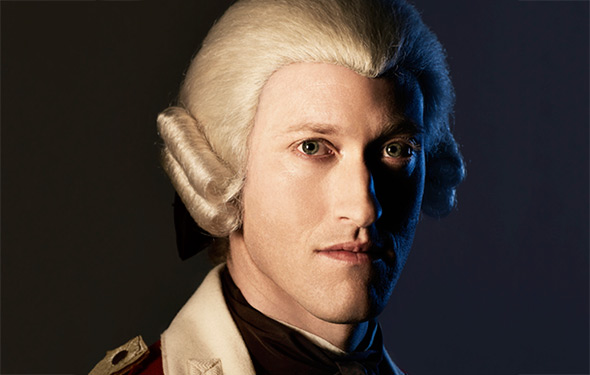
John Graves Simcoe as played by Samuel Roukin in TURN (Photo (c) AMC)
Enthusiasts of the American Revolutionary War would know Simcoe as the man in charge of the Queen's Rangers: a corps composed primarily of Loyalists and American deserters, and through which he gained a reputation as a tactician. For example, the Queens Rangers were deployed on reconnaissance missions during the war, including working alongside Benedict Arnold (yes, that Benedict Arnold - you see where this is going?) on his campaign in Virginia: the same campaign that led to the British occupation that's re-enacted annually at Colonial Williamsburg, Virginia, as Under the Redcoat.

Given all this, it comes as no real surprise that Simcoe bears a rather negative reputation in the US - and Benedict Arnold, at least, is a pariah in Canada as well due to his known switching of allegiances in the middle of the Revolution. So why would Toronto want to commemorate Simcoe with his own holiday?

Well, Canada is not the United States. And Toronto, especially, has a very different conception of John Graves Simcoe. Here, Simcoe is remembered as the first Lieutenant Governor of Upper Canada, a British colony founded in 1791 for the main purpose of accommodating United Empire Loyalists who had taken shelter in Quebec during and after the American Revolutionary War. Not only that, but it was Simcoe and the Queen's Rangers who first began work in 1793 on the colonial capital city of York. If this does not ring a bell, note that York is now known by a different name: TORONTO.

John Graves Simcoe and Augustus Jones, supervising the Queen's Rangers of York cutting trees during the construction of Yonge Street, 1795. Image by Charles William Jeffreys (c. 1795)
And there lies the crux of the question of why Simcoe Day got the name it did in Toronto, and only Toronto. John Graves Simcoe's historical significance here goes beyond what he is known for anywhere else in the province - my guess is that that's why the idea of naming Ontario's Civic Holiday after him didn't pan out. The government of Upper Canada, including the seat of the Lieutenant Governor, is in Toronto; and the first Lieutenant Governor was also the founder of said city.

What this says overall is that the same person can have very different reputations and stigmas attached to them historically depending on who is telling the story. And while TURN's Simcoe can at times be a right regular bastard, the Simcoe that Torontonians know and remember is very different man. Hero or villain? The truth is quite likely somewhere between the two.

Sources

Mealing, S. R. "SIMCOE, JOHN GRAVES." Dictionary of Canadian Biography Online. University of Toronto/Université Laval, 2003. Web. 4 Aug. 2014.

Schellhammer, Michael. "AMC's "TURN":  Everything Historians Need to Know." Journal of the American Revolution. 1 Apr. 2014. Web. 4 Aug. 2014.

Image Credits

All historical depictions of Simcoe in the public domain

Promotional image from TURN (c) AMC

Saturday, 19 July 2014

Historical Clothing for Sitters at the ROM's New Fashion Exhibition

Recently, the Patricia Harris Gallery of Textiles & Costume at the Royal Ontario Museum had been closed in preparation for a new exhibition. As a volunteer who is personally a bit more on the introverted side, I'm always aware of what goes on there, seeing as it is one of the quietest and most tucked-away areas of the museum. Well, as of June 21, it's re-opened with not one, but TWO new exhibitions. The first, Cairo Under Wraps: Early Islamic Textiles features some fascinating textiles and clothing from the 7th to 14th centuries. However, this post is about the second new exhibition that's opened up: Fashion Follows Form: Designs for Sitting.

The exhibition focuses on the work of Canadian fashion designer Izzy Camilleri, especially her line IZAdaptive, which was developed specifically for the convenience of wearers in wheelchairs. To do this, she drew off historical examples of clothing that were also designed with sitting in mind: riding habits, breeches/trousers, bustles, etc.

Now, I do not yet have images of Camilleri's own designs and pieces just yet: history nerd that I am, my first visit to the exhibition focused primarily on her historical sources of inspiration. So, here are some of the highlights from that particular subset.


Here, we have a 1770s English riding habit that was designed for a woman to wear sidesaddle. You can see that it was made in multiple pieces that simulated the coats and waistcoats worn by men. However, shorter's women's jackets were worn during the 18th century as well, so it's not simply about emulating menswear by any means.


Speaking of 18th century menswear, this was also a piece that was displayed as part of the exhibition. It is also English, and dates back to 1750. What served as Camilleri's inspiration here were the breeches. 18th century breeches were tailored very closely to the wearer's thigh. But can you imagine wearing skintight breeches made out of silk, wool, cotton, or linen? Those fabrics were less forgiving and elastic than today's synthetic materials, so trying to move in something that was too tight would be a wardrobe malfunction waiting to happen. So, in order to give a reasonable amount of manoeuvrability, 18th century breeches were also cut to be quite baggy in the rear.


You can really see the bulk in the derrière on this example: a pair of American breeches made between 1775 and 1799. So what's an elegant 18th century gentleman to do? Well, the long, flared skirts of the coat would have covered up this unsightly concession to practicality, thus enabling the wearer to keep up the well-tailored silhouette favoured at the time.

In fact, the coat's skirts also served another purpose re: sitting. There are slits on the side and back of the coat that allowed the skirts to be spread outwards while the wearer was seated (ex. in a chair or on horseback). This meant that sitting down did not entail sitting on a bunched up mass of fabric: again, a design created for comfort.

(On a side note: those slits also made it easier for the 18th century gentleman to wear his sword, which was a key part of formal court dress at the time!)

Now, moving on to one of the classic moments in 19th century women's fashions: the bustle.


This 1880s bustle was made in Canada, and is an example of the underpinnings worn by women in the latter decades of the 19th century. The bustle created a silhouette that emphasized the rear: instead of a bell-shaped skirt, the fabric would be swept backwards to drape down to the floor. Such a look, one would imagine, would make sitting difficult. But in this case, the bustle's structure made things easier: it is made in the style of a crinoline: rather than a solid piece, there are a series of metal pieces connected by strips of fabric. This meant that the bustle had sufficient give and freedom of movement to make it capable of bending when its wearer sat down.


Following along with the bustle silhouette, jackets like this 1887 dolman (of either English or American origin) were designed to flare outwards in the rear as well. Pretty, eh?

So where am I going with all of this? Namely that fashions for sitting are not a recent concession for accessibility or ergonomic purposes. There are plenty of historical instances when people have done the same, seeking to combine fashion with considerations of practicality. Yes, I know that from a 21st century perspective, the vast majority of 18th and 19th century fashions would not seem practical - but these pieces, in the eyes of their original wearers, were.

Image Credits

All photographs shown here were taken by Kita Inoru

Tuesday, 1 July 2014

Happy Canada Day from...Where???

Just posting to wish all my friends and followers a happy Canada Day. Yep, today, July 1, is Canada's main national holiday (unless you're in Quebec, in which case Canada Day vies for that honour with Saint Jean Baptiste Day - June 24 - but you get the idea). So it's the time when people commemorate Confederation and the creation of Canada as an independent nation on July 1, 1867.

BUT...I'm not actually IN Canada. Just my luck, I'm actually writing to you all while on vacation in the good ol' USA. I certainly haven't forgotten to showcase my Canadian pride, but since the outfit that I brought with me that's red and white also has some (very dark) blue in it, I daresay I look more like a Team USA fan today than a Canuck. This is what happens when Canada Day falls on the same day when the States is playing a World Cup match ;)

So, right now, I'm actually quite reminded of the line from the song "Canada's Really Big" by the Arrogant Worms: "So big we seldom bother to go see one another; although we often go to other countries for vacations..." Given that, I decided that for this year, I'll have some fun with you all for Canada Day and share some of the neat things that I've found over the years on the Internet that poke a little bit of fun at Canada and Canadians. After all, our stereotypes are harmless for the most part, so many Canadians do take some joy in laughing at themselves. Hope you enjoy these - and have a good Canada Day!

1. "S*** Canadians Say"

There was a meme like this going around on YouTube a while back, and here's some Vancouverites' Canadian edition:


2. "Canada's Really Big" by the Arrogant Worms

C'mon - I wouldn't reference this song without showing you what I meant! Also, little Canada Day challenge to any Hetalia fans out there: get through this video with a straight face. First one who succeeds, please let me know!


3. "Canadian Please" by Julia Bentley and Andrew Gunadie

This one, in my opinion, is a bit of a classic by this point - and it's definitely one of my own personal favourites.


4. "I Am Canadian!" by Molson Canadian

This one is the classically quintessential Canadian self-parodying commercial. It's quite old, but people still like it to this day.


5. "Olympic Relay" by RONA

This is a TV commercial that aired two years ago for the 2012 London Olympics. However, I think it's a humorous take on Canada's vast landscape and definitely worth a look.


6. "Canadian Idiot" by Weird Al Yankovic

Okay, this is not, in fact, by a Canadian artist; instead, it's Weird Al Yankovic's parody of Green Day's "American Idiot". However, since most of the Canadians I've come across who know this song think it's funny (and not offensive). So here you go anyway!


7. "Oh, Canada" by Five Iron Frenzy

Again, this one's actually by an American artist. But, again, I think it's funny - so enjoy!


And I think that's enough watching/listening to last you all a while! Once again, wishing everyone a safe and happy Canada Day, and I promise I'll get back to my more serious programming soon :)