Showing posts with label 17th Century. Show all posts

Sunday, 15 June 2014

Catch-22s in First Nations Depictions: The "Noble Savage" in History

This coming Saturday, June 21, 2014, is not just the Summer Solstice here in Canada. It is also called National Aboriginal Day, and is a time set aside to honour and acknowledge Canada's various indigenous peoples: the First Nations, the Inuit, and the Métis. So in this week leading up to National Aboriginal Day, I will be writing up a series of blog posts pertaining to the First Nations peoples in Canada: I've got four posts planned so far, but may do more if circumstances and inspiration permit.

There are a lot of things I can choose to focus on for this series, but I have settled on one broader theme: "Catch-22s in First Nations Depictions" refers to the times and contexts in which simplistic means of interacting with the First Nations peoples and their cultures simply fall apart. They are about the stereotypes and common images that have become predominant in how Canadians have come to perceive our First Nations - some more successfully and appropriately so than others.

Before I begin, a quick disclaimer: I, Kita Inoru, am NOT a person of First Nations descent. What this means is that the perspective and the opinions that I express here are solely my own. If there is anyone here who is of First Nations descent and/or is directly affected by the issues discussed in this series, please feel free to shed further light on them in the Comments, and please be patient with me in regards to any errors I might make. Thanks!

My discussion, then, begins with what is probably among the oldest and most iconic images that we have of the First Nations peoples in Canada: the Noble Savage.
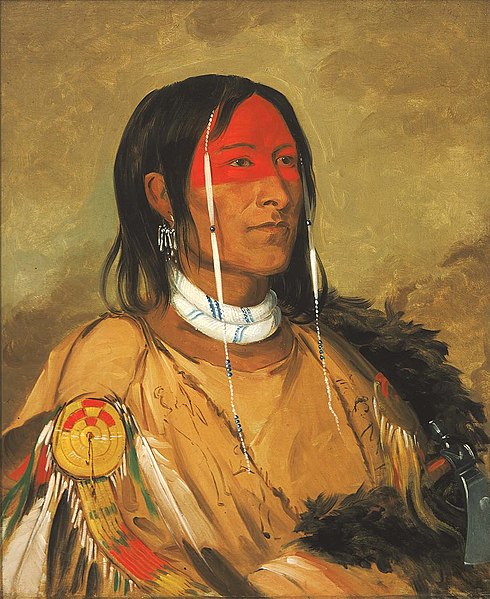
"Eeh-tow-wées-ka-zeet, He Who Has Eyes Behind Him (also known as Broken Arm), a Foremost Brave" by George Catlin (1832)
The concept of the Noble Savage goes back hundreds of years. Arguably going back even to the Roman historian Tacitus and his description of the Germanic tribes the Romans encountered in battle, the first known use of the actual phrase in English dates from 1672 in John Dryden's The Conquest of Granada. However, the concept - if not the phrasing - is most commonly associated with Jean-Jacques Rousseau; in his A Discourse on Inequality, he argues that mankind began in a primitive State of Nature that, while lacking government and technology, was far happier than the class system that evolved out of "civilization". For Rousseau, one of the main objects of his focus was the First Nations in North America, who he saw as having persisted in the State of Nature that he saw as the ideal for humankind.

For the most part, the Noble Savage is simply that: a "Savage" who exhibits "Noble" characteristics. However, I find that that does not show the sheer complexity in terms of how the First Nations have been perceived either historically or in the present day. The way, then, that I would like to examine this concept is to break it down into two main groups of characteristics: those that are "Noble", and those that are "Savage".

Detail showing an Iroquoian warrior in "The Death of General Wolfe" by Benjamin West (1770). This is now one of the most iconic representations of the Noble Savage in 18th century artwork.
In the 18th and 19th centuries, in artwork depicting the First Nations peoples, there is a certain nobility infused into the image. The Native is shown in a calm, almost stoic, pose: quietly contemplating either the surrounding events in the painting (as seen in Benjamin West's "The Death of General Wolfe") or the viewer (as seen in George Catlin's many portraits of First Nations people). He or she is usually shown wearing some sort of traditional dress or regalia: feathers, buckskins, paint, etc. Sometimes, the image is one of the Natives taking part in a traditional, pre-European-contact, way of life: hunting or fishing are common depictions. All in all, the image is one that shows the First Nations as people at one with the wilderness: content to stay that way for all eternity, but now having to face the encroaching European settlers that spell their inevitable downfall. The First Nations as "Noble" become romanticized tragic heroes for Europeans to contemplate, but not to help.

Conversely, and concurrently, there is the image of the "Savage". This is the concept of the First Nations as hardened warriors who raid European settlements, scalping, enslaving, and killing the inhabitants. It is the image that looms large in the French Jesuits missionaries' descriptions of the Haudenosaunee (Iroquois) in their wars with the neighbouring Wendat (Huron) and Algonquian peoples; in the many stories of "Indian captives" that sprung up during the Seven Years War (aka the French and Indian War, for those in the States); in the whispered tales of dread at the discovery that the British were enlisting the Iroquois on their side during the American Revolutionary War.

"Incident in Cherry Valley - Fate of Jane Wells" by Alonzo Chappel (1828-1887), engraved by Thomas Phillibrown (1856). Jane Wells is pleading for her life, and a man attempts to protect her from an Indian who is about to kill her. House behind them is being burned by Loyalists and Indians led by Major Walter Butler and Mohawk Chief Joseph Brant, Cherry Valley, New York.
For all that the First Nations were romanticized in history, the underlying fear and dread that European settlers in North America had of them never vanished entirely. Not only was there a conception that the First Nations were dangerously violent and unreceptive to "proper" rules of warfare, but the fact that many had societies structured entirely differently from the familiar Judeo-Christian model convinced many settlers that they were simply not to be trusted. In the case of Canada in particular, the Algonquian peoples were seen as lazy for their hunter-gatherer, semi-nomadic lifestyle (i.e. they were lazy because they did not farm the land and make full use of it as per God's command); inversely the Iroquoian peoples, who did til the land, were seen as barbaric in their torture of war captives, and backward in their matriarchal approach to leadership (i.e. the fact that women were often in charge meant both that they were insubordinate and that the men were weak).

It is the intersecting of the two sides of the coin - the "Noble" and the "Savage" - that reveals the unstable ground upon which European settlers in North America found themselves in trying to define the First Nations around and among them. However, regardless of whether the "Noble" or the "Savage" predominated in popular perception, the conclusion was the same. The settlers believed that the First Nations could not run the show for themselves anymore, but must be guided into a "better" way of life: either more "advanced" (in the case of the "Noble"), or more "civilized/moral" (in the case of the "Savage").

That may be the history, but the story itself does not end here. Stay tuned for the next installment of "Catch-22s in First Nations Depictions" to see how the duality of the "Noble Savage" has become manifest in today's societal views of the First Nations in Canada.

Sources

Bickham, Troy. Savages within the Empire: Representations of American Indians in Eighteenth-Century Britain. Oxford: Oxford University Press, 2006. Print.

Godesky, John. "'The Savages are Truly Noble'". The Anthropik Network, 10 May 2007. Web. 15 June 2014.

Rousseau, Jean-Jacques. A Discourse on Inequality. Trans. Maurice Cranston. London: Penguin Books Ltd, 1984. Print.

Image Credits

All historical artworks (c) Their original creators as indicated in the captions, found via Wikimedia Commons

Tuesday, 13 May 2014

Book Review: The Orenda by Joseph Boyden

I've been thinking what I should do for my first proper post here. I want it to be something that is relevant to both my interest in Canadiana and in history: something that could really show what this blog is going to be about.

Given that, I start with a Canadian historical fiction novel that was recently recommended to me by friends and colleagues: The Orenda by Joseph Boyden.


Dubbed the winner of Canada Reads 2014, The Orenda is one of those texts that has suddenly taken off as a piece of modern Canadian literature after it was published in 2013 by Joseph Boyden, an author of mixed First Nations, Irish, and Scottish descent. Perhaps, then, that it is fitting that he had chosen to write about a time of interaction and engagement between First Nations and European groups in Canada's early history.

As a whole, The Orenda is set within the area near Georgian Bay in Ontario - called Huronia by historians - during the 17th century. The focus is on three distinctive characters and their stories: Bird, a Wendat (i.e. Huron) elder and warrior; Snow Falls, a Haudenosaunee (i.e. Iroquois) girl whom Bird abducts and then raises as his own daughter; and Christophe, a French Jesuit missionary sent to convert the Huron to Christianity.

By examining the events from three different angles, Boyden is able to touch upon the complex issues surrounding French and First Nations relationships in the mid-17th century. Perhaps the narrative that would be the most immediately familiar to the audience would be Christophe's. Sounding like something straight out of the Jesuit Relations, we see in him both an aversion to the Wendat's customs and beliefs, and a growing sense of pity that further drives him towards fulfilling his vocation however possible. In contrast, Bird represents the existent Wendat system of beliefs: much of his narrative focuses on his meditations to his wife, deceased before the book's beginning, as he seeks to come to terms with the hardships faced by his village after the arrival of the Jesuits. Finally, Snow Falls lies somewhere in the middle. From her, we see something of a third party's perspective at first, when she still regards Bird as an enemy; yet, as the novel progresses, she comes more and more to integrate with the Wendat and consider herself one of their number. Against all this is the shadow that is cast by the Haudenosaunee throughout the text. Enemies of both the Wendat and their French "allies", there is a constant threat of violence that finally boils over in the book's concluding chapters.

Boyden has been criticized for his portrayal of the Haudenosaunee as brutally violent: torturing their war captives in increasingly sadistic ways. However, I do not consider that to be his fault alone. Much of the documented evidence we have from this time period comes from the Jesuit Relations: letters sent from missionaries back to France that are known to have grossly exaggerated their portrayals of Haudenosaunee atrocities in order to both prompt public support for Christianizing the Wendat and to give the Jesuits a sense of valorization in their martyrdom. Yes, the accounts were biased and painted the Haudenosaunee in an incredibly negative light; there is no denying that. Yet, because Boyden chose to tell the story from Wendat and French perspectives, how else would their enemies have been described in their own words? The only real remedy for that I could foresee would be if Boyden had also included a fourth voice: an individual from a Haudenosaunee community that stays Haudenosaunee throughout.

Boyden gives us many rich descriptions of Wendat customs: their feasts, their attitudes towards the dead, their agricultural cycle, their religious beliefs, etc. It is, for me, approaching a depth that I have rarely found in other novels I have read. In addition, the broader cast of characters allows for multiple perspectives to be given within any one group. Christophe's two colleagues, Gabriel and Isaac, for example, have very different approaches and attitude from him towards their mission - and for Isaac in particular, this ultimately leads to tragedy. For the First Nations, we also are granted a strongly traditionalist point of view in Gosling, an Anishnaabe who had become accepted by the Wendat as a medicine woman, and who serves as the primary voice of opposition to the Jesuits. In her, we see a strong voice that counters any preconceived notion that the First Nations were simplistic or primitive in their beliefs: Gosling holds her own against even Christophe, and often bests him in debate.

However, as someone who went into The Orenda with a curiosity as to how Canada's early history would be depicted, I found myself both satiated, yet wanting more. My greatest complaint here is in the scope of the novel. Ostensibly, The Orenda takes place between 1640 and 1650, during the height and the collapse of the Jesuit mission to the Huron. Yet outside of this vague description, the narrative feels strangely compressed. The story is described as taking place over a period of several years, but the historical events described, in fact, span from 1635 to 1649. In the beginning of the novel, there is a depiction of Samuel de Champlain at the end of his life (he died in 1635), and the conclusion reads like the final spike in violence from the Haudenosaunee against the Wendat and French described in 1648-1649. Hardly several years, that - and for someone with some knowledge of the historical background, the seeming compression of the story was quite frustrating to read.

Finally, though, what can be said about criticisms of The Orenda as a colonialist narrative? I do not know if that was Boyden's intention; his tripartite narration does suggest that he was aiming for a greater degree of complexity than if he had predominantly offered the French or Jesuit perspective as some of his predecessors (like Brian Moore in the 1985 novel Black Robe). Yet it is still the Wendat and the French that we, as the audience, are meant to sympathize with: the tragedy of the Wendat who were inadvertently decimated by European diseases (smallpox and influenza are specifically mentioned here) and then crushed by a Haudenosaunee fight against the French; and the Jesuit martyrs that formed the basis for the Catholic Church in French Canadian history for centuries to come and who could arguably be a precursor for the clergymen who ran the Indian residential school centuries later.

The Orenda is a broadening of the official narrative that Canadian schoolchildren grow up with, but it does not challenge it, nor go so far as to offer an alternative perspective. Perhaps, someday, a new novel could come along and allow the voice of the Haudenosaunee to be heard as well.

References

Boyden, Joseph. The Orenda. Toronto: Penguin, 2013. Print.

King, Hayden. "The Orenda faces tough criticism from First Nations scholar". CBC News., 7 Mar. 2014. Web. 13 May 2014.

Image Credits

Cover image for The Orenda (c) Penguin Canada Books Inc.