Showing posts with label 20th Century. Show all posts

Monday, 8 December 2014

The Kamloops Kid and Honda-San: Japanese Soldiers in Hong Kong

Earlier in this blog, I'd written about how the Canadians fighting in Hong Kong in WWII led to my reaching a greater awareness of Remembrance Day and its significance.

December 7, 1941, is a date that many of my readers would recognize: it was the day that the Japanese attacked Pearl Harbor, officially launching the United States into WWII. However, this was not a singular attack. Pearl Harbor was part of a co-ordinated series of Japanese military assaults throughout the Pacific Theatre, including the British colony of Hong Kong. Due to time zone differences, the attack on Hong Kong is recorded as having started in the early hours of December 8, 1941; hard fighting for the colony ensued between the Japanese and the defenders (made up of British, Indian, Canadian and native soldiers, at least) until the surrender on December 25, 1941. The surviving Allied soldiers were held as Prisoners of War until the end of WWII in 1945, and the story of these POWs is what often comes to Canadians' minds when they think of Hong Kong at the time.

But my focus here is not on the Canadian soldiers just yet. With all these anniversaries coming around at this time of year, I feel that focusing too strongly on that can stir up old conflicts and resentments towards Japan and its people. Sounds far-fetched? Maybe. But I have seen and heard such comments in person in the past (including claims that Japan deserved the 2011 Tsunami due to the Imperial Japanese Army's actions in WWII) to know not to bring that up. Rather, I want to encourage you, my readers, to step back and look at the Japanese involved in this conflict as people. Who were they, and how did this affect their actions?

Fortunately, my examination of the Canadian role in Hong Kong during WWII has managed to unearth accounts of (at least) two very different cases: one that falls into the common image of Japanese atrocities, and one that completely contradicts it. Both men are still shrouded in mystery, but please allow me to share what I have found thus far.

Kanao Inouye: the "Kamloops Kid"

 
Kanao Inouye was commonly known as the "Kamloops Kid" due to his being, in fact, a second-generation Japanese-Canadian born in Kamloops, British Columbia. He appears in a number of Canadian POWs' accounts of their imprisonment as an interpreter with a sadistic streak. One interview recalls him giving a POW a severe beating for pointing out poor medical facilities in the camp to a Red Cross worker, while other accounts point at Inouye's taunts, prophesying a Japanese takeover of Canada, and threatening harm to the Canadian POWs' families in that event. After the war, he was identified by POWs in Hong Kong, and was ultimately tried and executed for treason.

Something like this would correlate with many accounts of Japanese atrocities committed during WWII. However, there is more to Kanao Inouye than initially meets the eye, and much of this depth lies upon his being a Canadian citizen at the time. Like the United States, Canada and its government took preemptive measures to prevent traitorous behaviour from its Japanese immigrant population by confining many of them to internment camps well away from the Pacific coast. This is a dark spot on Canadian history, as at the time, Japanese-Canadians had not shown any indication of disloyalty to Canada, and, like their American counterparts, often worked to actively show their loyalty to the Canadian government during this time. So the "Kamloops Kid", then, was an exception instead of an indication of the norm.

So why did he behave this way if he was a Canadian citizen? As it turns out, anti-Asian sentiment was not new to Canada, and Inouye believed himself to have been a victim of bullying during his childhood in Kamloops, British Columbia. Although it was circumstances that led to his being conscripted into the Imperial Japanese Army - he had been studying abroad in Japan there when war broke out - his post near a large group of Canadian POWs prompted a spirit of vengeance. The Canadians in Hong Kong confirm this, noting that Inouye would, in the midst of his harsh treatment of the POWs, make remarks such as, "Now where is your superiority, you dirty scum?"

In other words, Kanao Inouye cannot simply be taken as an example of Japanese soldiers acting cruelly during WWII. His story is also a warning to Canadians and Americans in the present day of the dangerous consequences of racism: in short, racism breeds more racism.

Honda-san: The Mystery Good Samaritan

There is less out there on this man, from what I have seen. I have found several accounts of a Japanese officer and interpreter with the surname Honda who seemed to treat POWs more kindly and humanely than many of his fellows, but, in fact, I do not even know if these accounts point at one man or two. So for our intents and purposes, I will simply call him "Honda-san" ("Mr. Honda" in Japanese).

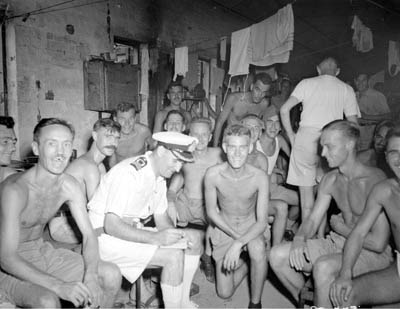
One account comes from a Canadian officer, Captain S. Martin Banfill, who was captured during a Japanese attack on the Salesian Mission in Hong Kong on December 19, 1941. Prior to the surrender, many POWs were summarily executed, but Banfill was singled out from his men and spared, ending up at a POW camp at the instigation of Honda-san. Had it not been for this, it is likely that Banfill would have died. Attempts to find this mysterious Japanese officer after the war proved futile; a man fitting his description was seen in Nagasaki when the atomic bomb fell on August 9, 1945, but there is no way of knowing if this truly was him or, if so, whether he survived the blast.

A second account comes from Lieutenant C. Douglas Johnston, who was sent to a POW camp after the surrender of December 25. The account of his imprisonment, in full, can be found here. In this, he makes several references to a Sergeant-Major or Warrant Officer, also with the surname Honda, who he describes as "a real gentleman". This was someone who, although known for strict discipline, also engaged with the POWs in conversation and seemed to show genuine interest in them. After the events of the war, Johnston recalls that the Canadian POWs sought to protect him in particular, allowing him to stay at Hong Kong's Peninsula Hotel to keep him safe from any generic reprisals against the Japanese.

Are these two accounts speaking of the same man? It is hard to say based on such little evidence (note that Honda is not an uncommon surname in Japan). But, in my opinion, there is a part of me that would rather these be two different people and two completely separate stories of human decency in the chaos of war. Just like a bad apple could spoil the bunch, particularly good ones can leave behind a very positive impression.

Sources

"C. Douglas Johnston's Story." Hong Kong Veterans Commemorative Association. n.d. Web. 8 Dec 2014.

"Kanao Inouye." Wikipedia. 12 Jan 2014. Web. 8 Dec 2014.

"Remembering the Kamloops Kid." Veteran Affairs Canada. Government of Canada. 19 Nov 2014. Web. 8 Dec 2014.

Roland, Charles G. "Massacre and Rape in Hong Kong: Two Case Studies Involving Medical Personnel and Patients." Journal of Contemporary History. 32.1 (1997): 43-61. Print.

"The Kamloops Kid." WWII in Color. n.d. Web. 8 Dec 2014.

Image Credits

Photo (c) WWII in Color

Saturday, 6 December 2014

December 6: A Dark Day in Canadian History

Every nation has one: a date that looms large in the national consciousness as the anniversary of some disaster or tragedy. Oftentimes, there's no need to provide details; those in the know will recognize what happened just by the date. For example, think of how easily we recognize 9/11: no-one needs to explain what took place or why it's important, as it is now simply a part of our culture.

Because of Canada's more behind-the-scenes role in world history, I don't think we have anything that resonates quite so much as 9/11. However, I do believe that Canadians have their own "dark day": December 6.

Not many people talk about it (compared to 9/11 at least), not even in Canada itself. But I would posit this as a suitable candidate for one of the darkest days in Canadian history. Why? Because not one, but TWO tragedies took place on December 6.

December 6, 1917: The Halifax Explosion

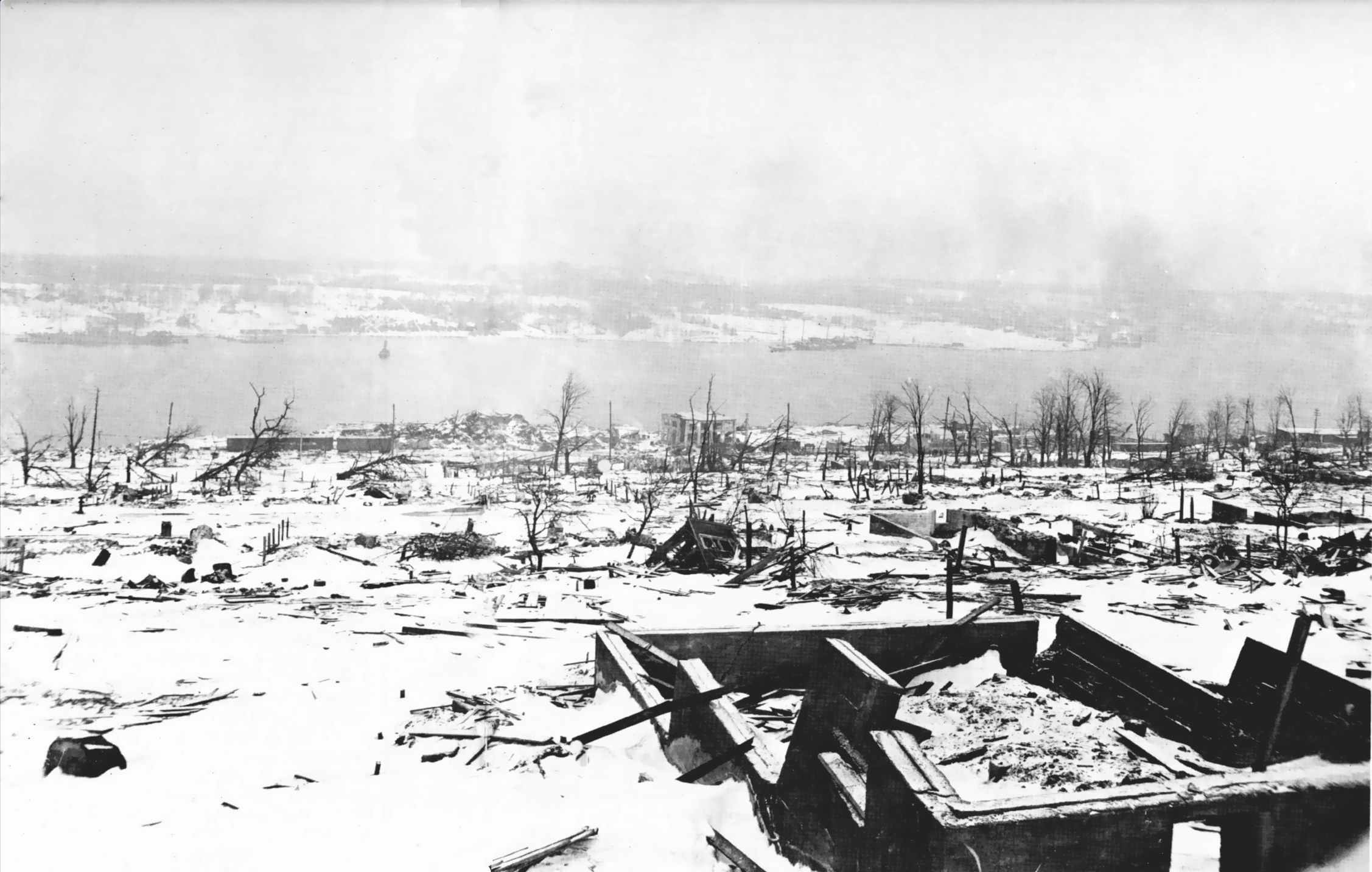
Aftermath after the Halifax Explosion (Image (c) Library and Archives Canada; Photographer unknown)
It was, for many Haligonians (i.e. residents of Halifax, Nova Scotia), just a normal day. Yes, Canada was fighting the Great War (aka WWI), and Halifax was a major port city at the time, ferrying supplies and soldiers to and from Canada and Europe.

With such a bustling harbour, perhaps it was only a matter of time before something went wrong. On the morning of Dec. 6, 1917, a Norwegian ship, the S.S. Imo, was scheduled to leave Halifax after spending several days refuelling before heading on to New York. She had originally been scheduled for a Dec. 5 departure, but had been delayed due to anti-submarine nets being placed in the Halifax harbour in the evening. So, by the next morning, she was eager to be underway.

In order to do so, however, she must pass through a channel known as the Narrows. Harbour protocol dictated that ships were supposed to pass each other port-to-port, each taking the starboard side of the channel in order to keep traffic running smoothly. However, to avoid collision with a tug-boat coming into the harbour at the time, the Imo swerved and overshot her turn into the Narrows, ending up closer to the port side than was safe. This combined with her going above the proper speed limit sent her straight into the path of the French ship SS Mont-Blanc that was entering the harbour at the same time.

Map of Halifax Harbour on the morning of Dec. 6, 1917, showing the Imo and Mont-Blanc in their original positions before the Imo began her exit and the Mont-Blanc her entrance. (Image (c) www.halifaxexplosion.org)
At 8:45 a.m., the two ships collided.

For all intents and purposes, the collision should have been a mild one. Both ships were travelling at low speed, and had already stopped their engines: it was their continued momentum in the time it took to stop that caused the accident. However, disaster was imminent due to two factors: the collision had caused a fire on the Mont-Blanc, and, being a cargo ship on her way to the European front, she was stocked full of explosives.

The Mont-Blanc's crew fled the ship, but the scene drew a crowd of spectators. It is understandable: on what was just a normal school and working day, a ship caught fire in the Halifax Harbour. It's the same sort of human behaviour that makes motorists slow down upon coming across an accident scene. So many Haligonians stopped what they were doing to go out to the harbour to watch, oblivious to the Mont-Blanc's cargo and what it meant. Even when the Mont-Blanc's crew tried to warn their rescuers about the imminent danger, they were not heard in the confusion.

At 9:04 a.m., the Mont-Blanc exploded, sending white-hot metal debris flying almost 300 metres into the air, which rained down on the city and its inhabitants. The shockwave destroyed the buildings within a 2.6 kilometre radius, but damage stretched far further to nearby communities and was felt in the other maritime provinces. On top of this, the explosion vaporized most of the water in the harbour, and the seawater rushing in to replace it swelled into a tsunami wave 16 metres high.

Halifax two days after the Explosion (Image in Public Domain, found via Wikimedia Commons)
All things told, 1,600 people were killed and 9,000 injured. Not only did this include dockworkers and sailors, but many civilians as well. Particularly horrific in hindsight is the fate of those who watched the Mont-Blanc's fire from their windows as the force of the explosion shattered the glass, blinding many people. The Halifax Explosion was the largest artificial explosion at the time, and would remain so until WWII and the development of nuclear technology. While Halifax has rebuilt itself since then and is now once again a major maritime city, the Halifax Explosion is still a major component of Canada's history: wartime and otherwise.

December 6, 1989: The École Polytechnique Massacre

Chances are, if there's one major Canadian disaster that took place on Dec. 6 that you'll be hearing about on the news, it's this one. Why? Because the events of the École Polytechnique Massacre led to December 6 now being memorialized in Canada as the National Day of Remembrance and Action on Violence Against Women. Perhaps that name alone suggests where this is going, but in short: this is the deadliest school shooting in Canadian history.

The École Polytechnique in Montreal, Quebec, as it appears today. (Photograph by MyName(Slp1) on Wikimedia Commons, Image used according to Creative Commons 3.0)
So what does a school shooting have to do with violence against women? It comes down to the shooter and his actions. On Dec. 6, 1989, Marc Lépine, aged 25, made his way to École Polytechnique, a post-secondary engineering school affiliated with the University of Montreal. There, he entered a classroom filled with approximately 60 students where a mechanical engineering class was in progress. This is where the violence against women aspect becomes apparent. After gaining control of the classroom, he ordered male and female students to opposite sides of the room. Then, after ordering the male students out of the room, he opened fire on the remaining 9 women, saying, "You're women, you're going to be engineers. You're all a bunch of feminists. I hate feminists." Of his victims in that classroom, 6 were killed and the 3 others wounded.

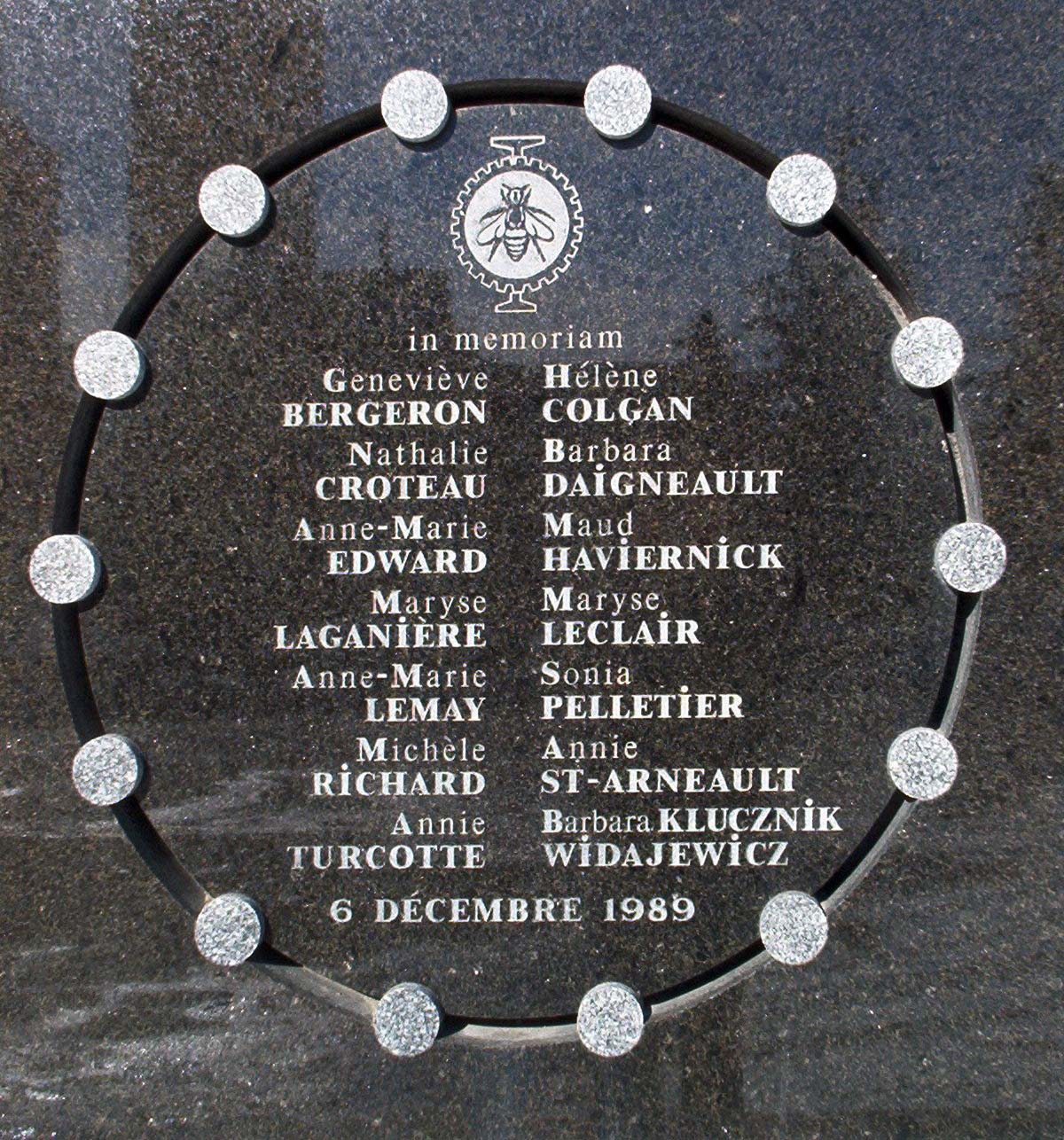
After this, Lépine continued on through the school, aiming his attacks at classrooms, students in the corridors, and a cafeteria, before shooting himself in the head. In total, 14 women (13 students and one employee) were dead, and another 14 people (including 4 men) were injured.

Commemorative Plaque at École Polytechnique listing the names of the deceased. (Image in Public Domain, found via Wikimedia Commons)
In the aftermath of the massacre, a suicide note was found in which Lépine reiterated his anti-feminist rhetoric. His view was that through feminism, women would retain their existing benefits from society and the government as well as claiming those that also belonged to men. In other words, and in my opinion, he confused feminism with misandry, and felt that any woman who sought a higher education (such as these students) or a career outside of what was traditionally feminine was a radical feminist and would ruin his own opportunities in life.

It's no wonder then that the anniversary of the École Polytechnique Massacre has become a day for remembrance, then, as Canadians continue to raise awareness of violent acts against women in general. However, I wonder if Lépine realized the coincidence his choice of date was creating. December 6 was already an infamous day in Canada - and he made it even more so.

Resources

"École Polytechnique Massacre." Wikipedia. 6 Dec 2014.

"Halifax Explosion." Wikipedia. 6 Dec. 2014.

HalifaxExplosion.org. 6 Dec. 2014.

Images

All images used under Creative Commons 3.0, individual credits in the captions

Tuesday, 11 November 2014

The Canadians in Hong Kong: Giving Me My Remembrance Day

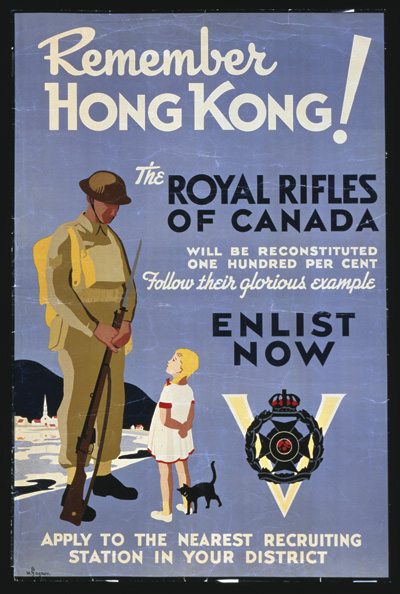
WWII Canadian Recruiting Poster referencing Hong Kong
When I was a kid, I didn't care about Remembrance Day.

Sure, in my head, I knew what it was about: every year, November 11 was set aside for Canadians to remember those who had given their lives for the country in WWI, WWII, and subsequent wars since. I'd attend the ceremonies, I'd wear the poppy, I'd recite In Flanders Fields, I'd observe the moment of silence.

But in my heart, I felt nothing.

Perhaps, if you understood where I was coming from, I would not seem so callous. It's not that I didn't appreciate the sacrifices made by our armed forces. I knew what they were fighting for, and supported it as wholeheartedly as the next kid in the classroom. My indifference to Remembrance Day didn't come from some overarching anti-war sentiment. It wasn't anything that noble. No. Little elementary-school-aged me simply thought there was nothing in Remembrance Day to remember. I wasn't born in Canada. My parents weren't born in Canada. I was just a little Chinese immigrant girl from Hong Kong who thought that this was all "white people's stuff".

You could, I suppose, pin some blame on the educational system for this. Because I know now that Canada's military history is, in fact, my military history. Not just because my views have become broader (although they have), but because of something that my school teachers had neglected to tell me: Not only was Hong Kong involved in the World Wars, but Canadians fought there, too.

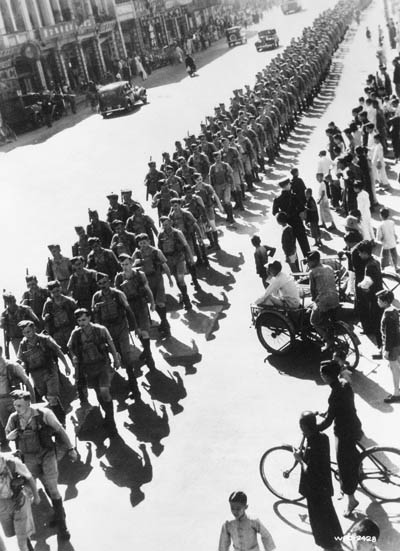
Troops of C Force en route to Sham Shul Po Barracks, Hong Kong, 16 November 1941.
So how did I find out about this? I did so on my own, seemingly by chance. During an eighth-grade school trip (the same one to Quebec City I'd mentioned in previous blog posts), we had made a stopover in Ottawa before moving on to Quebec. One of our destinations was the Canadian War Museum, where we were given some time to explore at will. I don't remember how I'd wound up separated from the group of classmates I was with when we were in the section devoted to WWII (although I do remember something about them looking at Hitler's car). But regardless of how it happened, I was, for several minutes, alone, having gone deeper into the exhibition hall than anyone else.

And that's when I saw him.

Sounds creepy, yes, but in fact, it was. I've become quite used to seeing models and mannequins in museums by this point, but back then, aged 14, I wasn't. Besides, I was on my own in a museum exhibition about the Canadians in WWII: it was dim, quiet, and just a bit eerie to begin with. The last thing I was expecting to see out of the corner of my eye was the figure of a tall, dirty, Caucasian man, shirtless and clad only in a pair of ragged khaki shorts, standing with his head bowed and his hands stretched out in front, holding a small bowl.

Again, in my head, I must have known that this was simply a model, but that didn't stop me from both being scared out of my wits, and inexorably drawn to him. I knew that I shouldn't be going deeper into the exhibition - I'd get in a good deal of trouble if it was discovered that I was alone, separated from the group and unsupervised. But I did anyway. I wanted to find out who this man was, and why he looked the way he did. After all, I was expecting to see figures of men in uniform, not something so pathetic as this.

And it's at this moment when Remembrance Day for me changed forever. I couldn't bring myself to look at the man directly for very long, but I gleaned enough to discover that he was a representation of the Canadian POWs who had been captured after losing to the Japanese in Hong Kong in December 1941.
Canadian and British prisoners-of-war liberated by the boarding party from HMCS Prince Robert, Hong Kong, August 1945.
It was years later before I tried to look up the events in any amount of detail, and perhaps that is a story best saved for another day. In short, Canadian troops were sent to defend Hong Kong, a British colony at the time, from the encroaching Imperial Japanese Army. On December 8, 1941, at the same time as the attack on Pearl Harbor (on December 7, 1941 - timezone differences), the Japanese began their offensive against Hong Kong in earnest. Along with other British Commonwealth troops, the Canadians tried to push them back, but ultimately conceded defeat and surrendered on December 25, 1941.

If anyone here is surprised to find out that either Hong Kong or Canada were involved in the Pacific Theatre in WWII, I don't blame you. That is, after all, what I thought until I was 14. Since then, I've both come to a better understanding of what Canada's forces did all over the world, not just in Hong Kong, and Remembrance Day has become closer to my heart in more ways than one. Perhaps too close, and not always in ways relating to the military, but still: close.

So today, on November 11, 2014, I want to say this to those Canadian soldiers who fought in Hong Kong all those years ago, and their descendents: Thank you. Not only did you do your utmost to defend my land and my people, but you have also helped to shape me into the Canadian that I am today, over 70 years later.

Image Credit

WWII Poster (c) Canadian War Museum

Photographs (c) Library and Archives Canada

Wednesday, 18 June 2014

Catch-22s in First Nations Depictions: The "Noble Savage" Today

Continuing with my series leading up National Aboriginal Day on June 21....

Last time, my focus was on the popular conception of the "Noble Savage" and the various stereotypes of First Nations peoples that myth generated historically. If you haven't had a chance to read that, please do: http://kitainoru.blogspot.ca/2014/06/catch-22s-in-first-nations-depictions.html 

This time, my focus is shifting more towards the present day. While the exact myth of the "Noble Savage" as previously discussed does not hold much water anymore, I think that it has not so much disappeared as evolved. Even now, many Canadians continue to see the First Nations as either "Noble" or "Savage", albeit under different names.

But before I begin, a quick disclaimer: I, Kita Inoru, am NOT a person of First Nations descent. What this means is that the perspective and the opinions that I express here are solely my own. If there is anyone here who is of First Nations descent and/or is directly affected by the issues discussed in this series, please feel free to shed further light on them in the Comments, and please be patient with me in regards to any errors I might make. Thanks!

Recall from the previous installment in this series that I have grouped historical stereotypes of First Nations peoples under two main categories: the "Noble" and the "Savage". For the most part, they could easily be thought of in terms of positive and negative characteristics: those that make us think of the First Nations as "noble", and those that make us think of them as "savage".

First Nations dancer in regalia, from the Vancouver First Nations Exhibition on June 23. 2008 (Photo by Philippe Giabbanelli)
So how does that work nowadays, in the 21st century? Surely, outside of Hollywood depictions, artwork, and historical re-enactments, people don't still believe that the First Nations are simple hunter-gatherers who feel the ever-pressing encroachment of the "white man" and, at times, resort to violence to push them back. This is, after all, the 21st century! A time of advanced technology, greater tolerance, and a better appreciation of the cultural diversity in Canada.

Actually, about that....

True, the actual details and trappings of the myth of the "Noble Savage" are well known to be just that: myth. Canada's First Nations have a sufficiently active presence in society and culture for that to be immediately apparent. However, that is not to say that the core distinctive divide in the stereotypes no longer exists. The details might vary, but the heart is still there. Canada's First Nations are still associated with a host of both positive and negative stereotypes. And while positive stereotypes might be "better" than negative ones, it's hard to tell which set of the two really wins out at any given moment.

The First Nations as "Noble"

"Noble" stereotypes attached to today's First Nations peoples abound. These traits, in my opinion, are the ones that tend to lead people to express some deep sense of admiration for Native peoples and their cultures. I do want to say that while there is a great deal of fact in these stereotypes - and that they are certainly positive ones - that the danger here comes in automatically assuming that all First Nations people are going to fit these traits. Individuals are what they are, and that's not going to change.

1. The First Nations as "Earth Stewards"

 This one is probably the first one that will come to most people's minds: the idea that First Nations people are innately environmentalists who preach being "at one" with nature. It's the image that we see in the popular "Indian Prophecy" message that has shown up on a number of Internet memes and inspiration posters: "Only after the last tree has been cut down; only after the last river has been poisoned; only after the last fish has been caught; only then will you find that money cannot be eaten." The point of this message is that the First Nations are seen as staunch protectors of the wilderness and natural environment - and are, because of that, morally superior to those who seek to simply exploit Canada's natural resources for monetary gain.

The one-year anniversary event for Idle No More in a shopping centre in Burnaby, British Columbia. (Photo by Eviatar Bach)
Those who are aware of, say, the recent Idle No More movement and other First Nations incentives to curb the oil sands, fracking, etc., can see that there is a foundation of truth to this. However, things get a bit more complicated when we combine this with another major "Noble" stereotype:

2. The First Nations as Spiritualists and Animists

This one, I think, is best summed up in what was my own first exposure to First Nations peoples growing up: Disney's Pocahontas. Many of us would be familiar with the major musical number from the film, "Colours of the Wind". Well, if so, you may recall this line: "But I know every rock and tree and creature / Has a life, has a spirit, has a name". It's the image that makes First Nations spirituality so appealing to people who are seeking something outside of the stricter regimentation of many established religions. So think of things like the recent obsession with totem animals, dreamcatchers, sweat lodges, Native ceremonies, etc.

In a way, this particular aspect of the "Noble" is focused on the idea that the First Nations peoples possess a wisdom and moral strength that the rest of the world (especially those of Caucasian descent) have somehow lost. However, if that is the case, then one must be careful not to run too far with that idea - or one risks going from the "Noble" into the "Savage".

The First Nations as "Savage"

Now, the word "Savage" can carry a few different meanings. It obviously bears a very strong negative connotation either way, but there are two particular ways where I think the First Nations are still perceived as "Savage", even in the present day.

1. The First Nations as Primitives

This, I will confess, can very easily come out of a lack of exposure. When historical and/or stereotypical images are maintained and continue to be disseminated, it's inevitable that we will have a significant group of people for which that is their ONLY encounter with the First Nations at all. It's because of that that there is, out there, a stereotypical image that people have of Canada's First Nations people: that they are hardcore traditionalists and always appear in feathers and paint.

First Nations dancers in regalia at the Opening Ceremonies of the 2010 Vancouver Winter Olympics (Photo by Voice of America)
The problem here is that this assumes that First Nations cultures are static and have not changed over the years, with the further - darker - implication that they will forever wish to dwell in the past and will not or cannot "modernize". That can take us into very dangerous territory, as it's that exact type of thinking that led to many of the discriminatory policies towards the First Nations peoples throughout Canada's history, such as the Indian Residential Schools.

Also, the logic behind that stereotype is flawed in and of itself: all cultures evolve and do not lose their authenticity for doing so. Even as far back as the 18th century, many First Nations peoples who traded with Europeans were adapting to new ideas and practices: wearing shirts and trade cloth rather than skins, using muskets rather than bows and arrows, etc. The cowboy movies that show otherwise are just that: movies. But that's the image that persists in people's minds even to this day.

Finally, and quite possibly worst of all:

2. The First Nations as Corrupt

The actual form that this takes varies substantially. But it's one of the most common conceptions of the First Nations in the 21st century. Here, I am speaking of anything associated with alcoholism, drug abuse, obesity, domestic violence, suicide, sexual harassment and assault...you name it, it's there. Most of this gets pinned on to the First Nations communities that are still on the reservations. And while there is abject poverty in many of the reservations that do, statistically, contribute to these problems, just blowing off the First Nations as being "like that" isn't going to help.

On top of that, the old belief that the First Nations were "lazy" still persists to this day. Whereas historically, the stereotype came out of a lower emphasis on agriculture in many First Nations cultures, it now stems from the popular conception that First Nations reserves simply rely on substantial government handouts that are paid for by hardworking taxpayers, and that the poverty that is readily apparent comes from corrupt chiefs and elders pocketing all the funds for their own personal use. Quite a wide brush to paint an entire group, in my opinion!

I will admit that I myself do not have the statistical knowledge to know whether there is any truth to this belief. But I am also unwilling to gamble on the chance of its veracity to use it to automatically justify a refusal to intervene for innocent people and/or communities who are actually in need.

In conclusion, then, the historical concepts of Canada's First Nations as "Noble Savages" does still persist to at least some extent today in the 21st century. For the remainder of this series, then, I will be turning my focus to some practical ways that non-First Nations people like myself could show respect and/or support for the First Nations and their current needs and issues.

Image Credits

All images (c) their original creators as indicated in the captions, and are used here under the terms of Creative Commons Attribution 3.0 license

Friday, 6 June 2014

Juno Beach: Canada's Pride of World War II

Today, on June 6, 2014, there are people all across the world who are stopping to reflect upon D-Day and the assault on Normandy. Seventy years ago today, a joint British, American, and Canadian force worked to push back the German forces that were posted on the beaches of Normandy, in northwestern France. Their success that day is now remembered as a significant turning point in the War: the opening of a western front from which point the Allies could force the Germans back to their own borders. It's an event that's so well known that it has been immortalized in song and film several times ever since.

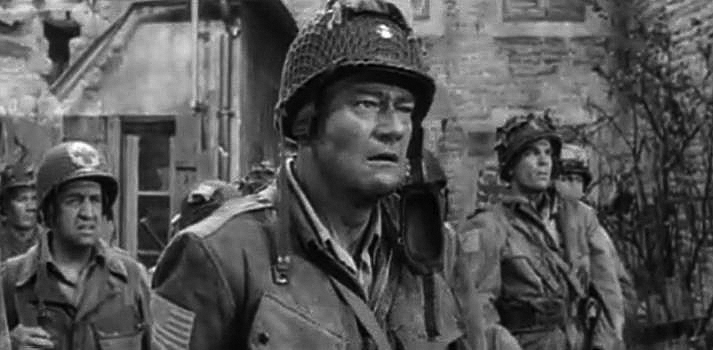
John Wayne in the 1962 film The Longest Day
That's a rather older example, and not all that familiar to those in my generation, I daresay. But what about this one?

Screenshot of the Normandy landing from Saving Private Ryan.
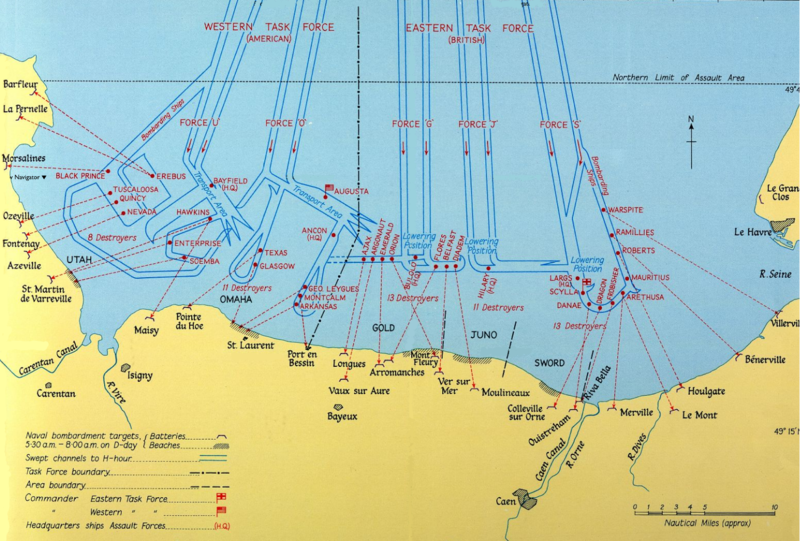
The point is that D-Day has become associated with two things, primarily: Allied determination, and extreme bloodshed. Doubtless it was a bloody, hard-fought battle: just the immense scale of the operation should give that away. Five beaches were attacked by the Allies on June 6, 1944. From west to east, these beaches were code-named Utah, Omaha, Gold, Juno, and Sword.


Hollywood, being what it is, has tended to focus on the two beaches that were tasked to the American forces: Utah and Omaha (it is the latter that is shown in the opening scenes of Saving Private Ryan, for instance). The British were focused on Gold and Sword. That left Juno to the Canadians - and it has been a great source of national pride ever since.

Canada was heavily involved in the fighting during both WWI and WWII. As a nation and military force, Canada does not hold the same level of prestige as Britain, the United States, France, Germany, etc. In both cases, it is because the Canadian efforts have been seen as joint efforts with others. In WWI, Canada was a dominion of the British Empire, and did not even hold sufficient right to declare war on its own: once Britain was in, Canada was in, no ifs, ands, or buts about it. As for WWII, although Canada had attained enough international clout to issue its own declaration of war and handle its own international affairs, it was still popularly conceived as "British".


Lance-Bombardier Walter Cooper, 14th Field Regiment, Royal Canadian Artillery (R.C.A.), aboard a Landing Ship Tank counting out 105mm. shells which will be fired on D-Day. Southampton, England, 4 June 1944. (Photograph by Lieut. Frank L. Dubervill)

What this means is that like the other Commonwealth nations (ex. Australia and New Zealand), Canadians have taken particular responsibility in remembering their own achievements from WWI and WWII. For Canadians, then, we then sought out instances where our soldiers have gone above and beyond the call of duty to create something significant not just to our own history, but to the wars' progression overall. In WWI, that lot fell to Vimy Ridge (April 9-12, 2917); and in WWII, although the credit could be more diversely distributed, most of the emphasis has fallen upon Juno Beach.


Infantrymen of The Highland Light Infantry of Canada aboard LCI(L) 306 of the 2nd Canadian (262nd RN) Flotilla en route to France on D-Day, 6 June 1944. (Photograph by Lieut. Gilbert Alexander Milne)
 Why Juno Beach? Because there was, in fact, a Canadian distinction involved. It's something that many Canadian schoolchildren know, and it's reiterated year after year on Remembrance Day (November 11) and also on the anniversary of D-Day itself: the Canadian troops were the first to reach their assigned goal out of all the Allied divisions involved, and - because of that - were able to penetrate further into German-occupied France than any of the others on that day.

Now, I'm not a military historian. I can't tell you the hows of Canada's victory at Juno Beach, or why the Canadians were the first to achieve success. There are plenty of books, websites, etc. addressing that issue, I reckon. All I want to do is give the Canadian troops that took part in D-Day their proper recognition. Hollywood might give us the American story, but D-Day was a joint effort - without each force involved doing its part, the offensive as a whole may not have succeeded.

And I think, for Canada, seventy years later, that's what matters most.


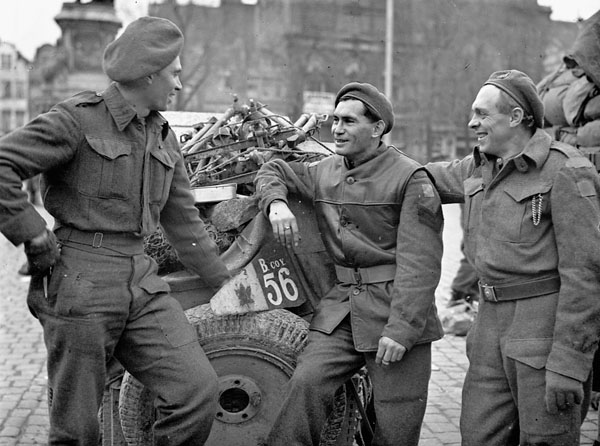
Three "D-Day originals" of the Regina Rifle Regiment who landed in France on 6 June 1944. Ghent, Belgium, 8 November 1944. (Photograph by Lieut. Donald I. Grant)
Private C.L. Jewell of The North Nova Scotia Highlanders, who wears a "D-Day" beard, Normandy, France, 22 June 1944. (Photograph by Lieut. Ken Bell)

Rifleman R.A. Marshall, Queen's Own Rifles of Canada, pointing out a hole in his helmet made by a German sniper's bullet on D-Day. Bretteville-Orgueilleuse, France, 20 June 1944. (Photograph by Lieut. Frank L. Dubervill)
Oh! One more thing. There is, in fact, a film out there focused on the Canadians at Juno Beach: Storming Juno. Based directly off the experiences of three actual soldiers who took part, it does a great job of making the story relatable while keeping the history accurate. If you haven't seen it, I highly recommend it. Here's the trailer, just for starters.


Image Credits

Screenshot from The Longest Day (c) 20th Century Fox

Screenshot from Saving Private Ryan (c) Amblin Entertainment

Map of Normandy Beaches (c) HMSO (Her Majesty's Stationary Office) and the National Archives (UK)

All photos of Canadian forces in 1944 (c) Library and Archives Canada