Showing posts with label First Nations. Show all posts

Monday, 5 January 2015

A Canadian's Review of the Canada Pavilion in Disney World's World Showcase

It's that time of year again: Christmas has passed, and everyone is getting back into their old grind of school and work. I hope everyone here among my readers has had a safe and enjoyable holiday season - I know I have. And that's why I'm here: to talk about where I was.

Shouldn't take a genius to figure out where I was if I got photos like this!
From December 22 to 27, 2014, I was on a family vacation to Disney World in Orlando, Florida. That's close to a week, and I still wasn't able to even scratch the surface of what the parks and resorts had to offer. However, I was able to, fortunately, check out my favourite part of the entire complex: the World Showcase in Epcot.

For those of you who aren't aware, the World Showcase is designed to feel like a one-stop-shop trip around the world. There are areas - called Pavilions - focusing on 11 different countries: Mexico, Norway, China, Germany, Italy, the USA, Japan, Morocco, France, the UK, and Canada. Naturally, being a very patriotic Canuck myself, I made a point of paying particularly close attention to the Canadian one.

It should be very obvious that, with the sheer amount of possibilities inherent in every nation's culture, the representations in the World Showcase are kitschy at best, and downright stereotypical at worst. That still didn't detract from my enjoyment, though - not this time, nor the first time I went back in 2010.

So...what was it like for this Canadian to see how Disney chose to show my country to the world? Let's find out!

I ended up approaching the Canada Pavilion from the side of Epcot known as "Future World"; in other words, this was the first "country" I visited in the World Showcase. However, before I even got into the Pavilion proper, there were already clues that I was in "kitschy Canada":


See those? They were in a kiosk promoting the Disney Vacation Club, and the first thing I saw entering the World Showcase. If you think those look an awful lot of Northwest Coast First Nations art, you'd be correct. In fact, that was a running theme throughout the Canada Pavilion: just like any proper souvenir shop back home, you can't say "Canada" without some nod to our First Nations, particularly those from British Columbia. Take a look at some of these other examples - this time from the actual Pavilion:

First Nations totem pole and a Haida house as a storefront.

Not only does this give a good view of the wall artwork in the gift shop, but you can also see how the staff at the Canada Pavilion were dressed. The cashier is wearing a white shirt, a leather fringed vest, and a red plaid skirt. Guys word red flannel plaid "lumberjack" shirts.
Carving on the front door to the gift shop.
The shop that these photos is from is also worth mentioning. Oftentimes in the World Showcase, the stores for each "country" are connected internally: you walk through them as one cohesive unit, but there are various different storefronts on the outside all along the way. The one for the Canada Pavilion, for instance, was made up like an old fur trade post in one part, and a Haida house (see above) in another.

Inside these stores, there are many souvenirs that are meant to be reminiscent of the nation being represented (although, with the recent boom over Frozen, "Norway"'s shops seem to have lost some of that in favour of being Disney's latest place for more Arendelle-related merchandise). And the Canada Pavilion is no different. Here, I found more than my fair share of maple-related goods, hockey paraphernalia, etc.

Maple-flavoured goodies - Yum!
Winnipeg Jets gear for sale in the gift shop. There were shelves like this for all of Canada's NHL teams (the Vancouver Canucks, Edmonton Oilers, Calgary Flames, Winnipeg Jets - shown here - Toronto Maple Leafs, Ottawa Senators, and Montreal Canadiens). This is my nod to Canada's newest :)
Also, because it was the Christmas season, the entire store was also decked out with holiday gear: wreaths, garlands, snowshoes....Yep, there were snowshoes worked into the garlands here.

Perhaps I really shouldn't be so sardonic about all of this. In all honesty, I really liked what Disney did in this Pavilion, and I get a good laugh out of it every single time. But, let's be honest: no Canadian I know works snowshoes into their Christmas decor. Then Again, "We Are Winter" (Team Canada slogan and all that), so I suppose it only makes sense that we'd be associated with ice and snow all the time.

Speaking of snow, nature in general is a huge running theme in the Canada Pavilion, at all times of year. And it makes me really proud to see my country being associated with such gorgeous (albeit man-made) vistas as this:

That, mes amis, is an artificial mountain formation that acts as a backdrop for the entire Canada Pavilion. It is absolutely stunning to see in person - and very easy to forget that it's all man-made. I am very, very glad that Disney decided to think of "wilderness" when they thought of "Canada", because that is something many Canadians, too, are proud of. Yes, the wilderness is tough, and winters are tough, and we gripe about them all the time. But, all the same, we Canucks won't have it any other way.

There is also a nod to one of Canada's most well-known man-made landscapes. Victoria Gardens, as this area is called in Epcot, is directly inspired by the very real (and very famous) Butchart Gardens in Victoria, British Columbia.

Now, Canada is not just about the First Nations, hockey, and nature. There has also been a long history of European (predominantly French and English) settlement, and that is marked in some of the architecture here as well, inspired by buildings seen in Ottawa and Quebec.

Reminds me of the houses I saw in Quebec City
This building is inspired by the Château Laurier hotel in Ottawa
So...are there any rides in the Canada Pavilion? No. However, there is, if you ask me, one heck of a good show: "O Canada". It's a Circle-vision movie, meaning that you stand in the centre of a room and images are projected on a screen that wraps all the way around you, and shows a lot of what Canada has to offer, narrated by one of our many comedians: Martin Short.

And, perhaps as a nod to how Canada's economy relies predominantly on its natural resources, the theatre is inside an old mine:

Just how good is this movie? Well, it can be a bit disappointing, after spending a long day walking, to discover that it's just standing-room only in the theatre. However, everyone in my family thought it was great, and that our country was certainly worth "standing on guard" for. (And, yes, that's a very lame attempt to work the actual "O Canada" into this!)

So what's my overall verdict? As a Canadian, I could see this pavilion for being the mishmash of stereotypes it is - more so than I could have for any other Pavilion in the World Showcase. However, I do commend Disney for choosing the particular set of stereotypes it did: these are all things that many Canadians, myself included, do feel proud about, and I, at least, am more than happy to use them as markers of our distinctiveness as a nation.

Bonus

Just for the record: the question of "Where are you visiting from?" is a huge icebreaker while you're in Disney World. Everyone asks it of everyone else: characters during autograph sessions, other visitors whilst you're in line, the cashiers in the stores. Naturally, I joined in the fun, and had some great conversations this way. Here are my top picks for "I'm a Canadian!" moments at Disney.

1. Waiting in line for Winnie the Pooh's autograph in the United Kingdom Pavilion, I started chatting with the family in front of me in line. It turns out they're from Winnipeg, Manitoba, and were happy to have a fellow Canuck in their midst. As we waited, we remarked on the irony that Winnie the Pooh was considered a British character by Disney when Winnie, the actual bear that inspired the story, was Canadian and named for Winnipeg. Seriously - look it up. Granted, A. A. Milne was British, and he saw Winnie at the London Zoo, but, well, the Canada Pavilion has no character greetings, and the UK already has Alice in Wonderland and Mary Poppins - let us join in the fun, why don't you, Disney?

2. The first thing I did when I arrived at Disney World was buy an autograph book at the gift shop in my hotel (the All Star Sports Resort). Every single time I buy something in the States, I have to wrap my head around all the bills looking almost exactly the same. I told the cashier as such, and he asked me where I was from. I answered, "Toronto, Canada. I'm used to the technicolor money we have there." He thought that was funny, and it did break the ice a bit.

Speaking of "ice", here's a very famous Canadian whose photo was featured on a "Wall of Fame" in the hotel: Wayne Gretzky, NHL hockey player from the Edmonton Oilers (aka "The Great One").
3. Meeting Elsa from "Frozen" at the Magic Kingdom Park. Yes, I was one of those who got the coveted Fastpass+ to see her (book early, guys, or you'll be in line for HOURS). She asked me, while signing my book, where I was from, to which I answered that I was from Canada. She then said, "I've never been to the Kingdom of Canada before," and then said that she'd like to go because of all the ice and snow. Actually, both she and Anna remarked on how cold it must be there. I deigned from telling Elsa, however, about how Toronto quite literally froze over last winter; don't know how she would have reacted if I did.

Edit: I've been notified via e-mail by a reader that I accidentally left out the Ottawa Senators from my list of Canadian NHL hockey teams. That's been fixed, and I apologize - no offense was intended to the Sens or their fans.

Image Credits

All photos (c) Kita Inoru

Tuesday, 2 December 2014

Six Months In: Things I've Learned as a Gallery Interpreter at the Royal Ontario Museum

In terms of my volunteer work at the Royal Ontario Museum, I have recently hit a personal milestone: I have completed my time as what's called a provisional Gallery Interpreter (i.e. a trainee volunteer) and am now officially an active member of the ROM's Department of Museum Volunteers. I do get some perks from this: best one being my own ID badge/key card so I don't need to trouble fellow volunteers to let me in each time I show up for a shift.

The ROM's famous Rotunda Ceiling mosaic. The text reads: THAT ALL MEN MAY KNOW HIS WORK
So what's a Gallery Interpreter, you ask? What we do is go out into the galleries with a small specimen or artifact that visitors could interact with. Engagements take the form of a short Q&A session, where we use guiding questions to offer information about both the object(s) we have, and the surrounding relevant museum displays. I myself spend most of my time in the two Canadian galleries at the ROM - the Daphne Cockwell Gallery of Canada: First Peoples; and the Sigmund Samuel Gallery of Canada - with one specimen each: a miniature replica birchbark canoe in the first, and a late 19th-century French-Canadian maple sugar mould in the latter.

A "period room" set up in the style of 16th century England in the Samuel European Galleries at the ROM. This is an example of one of my favourite parts of the museum, albeit not where I actually work.
Officially, I have only been a Gallery Interpreter since this past July, but before that, there had been more rigorous training where I had gone out into the galleries accompanied by a more experienced GI (as we're called for short), meaning that I have been out and about in those galleries for approximately half a year by this point. And in this half a year, I have learned a lot of valuable lessons along the way: things that I am sharing with you now as some of my favourite highlights thus far in my life as a Gallery Interpreter at the ROM.

1. Nothing quite beats working with historical objects.

Especially when said objects just happen to be particularly old, or beautiful, or relevant to your field of interest. I still remember when, in the early stages of my training (i.e. before I was even in the galleries), I was given a demo from an instructor on how one of these Q&A sessions would work. The gentleman had a piece of mosaic with him, and I was to pose as the "visitor". I knew going into the dialogue that the mosaic was used in the ROM's Ancient Roman gallery, but imagine my surprise when I discovered that the fragment I was handling was actually 2,000 years old, and a genuine artifact! And since our initial training included objects from both the ROM's Natural History and World Culture collections, I'm sure that's not even the oldest thing I handled by the time I was done.

2. The fascination applies to visitors as well.

I daresay some of the giddiness that comes from working with historical artifacts might seem to come just from my being somewhat of a history enthusiast. However, it's not just me or fellow museum volunteers and employers who get like that: the visitors do, too. For instance, while the miniature birchbark canoe I work with is a replica, I stand near some First Nations birchbark canoes that are well over a hundred years old. And people love it when I point that out!

One of the original First Nations birchbark canoes at the ROM. I work with a smaller, miniature version when I chat with visitors.
The same sort of thing happens with the maple sugar mould as well. Many visitors are fascinated by the fact that not only am I holding an artifact from the late 19th century, but that (with gloves and my supervision) they are welcome to touch it as well. GIs are trained to make sure that artifacts are handled with care at all times (for example: cupping our hands below the visitor's to catch any objects that might fall), so it's a fun and safe experience for everyone involved.

3. Some people just want to be taught.

I've seen this a number of times already in the past six months. The intent for the GIs is to engage with visitors in a conversation, and the Q&A idea stems from that. However, I have had several instances where visitors who are interested don't want the preamble. They'll come right up to me, point at what I'm holding, and ask, "What is that?" Depending on the overall tone of the conversation so far, I sometimes respond by asking for guesses, but it certainly has happened where I end up just telling them directly, and the visitor is very appreciative for the information. This happens a lot with the maple sugar mould in particular, since it's not as immediately recognizable an object as the birchbark canoe. I can see how trying to guess what it is can be rather intimidating, actually.

19th-century French-Canadian maple sugar moulds at the ROM.

4. Sometimes, I am the one who gets taught - and that's even better.

Just about every single GI has had an encounter like this: a visitor comes by who turns out to be an expert in the field relating to the object in question. I hear a lot of these stories coming from the Natural History sections of the ROM in particular, especially relating to children who are currently in their dinosaur/animal enthusiast stage.

I myself have had a similar experience with the miniature birchbark canoe. One woman I met turned out, in fact, to be First Nations herself (specifically Ojibway) and made similar miniature canoes as a hobby. So she was the one telling me a lot about the process she used: soaking the birchbark to make it pliable, sewing it with sinew (the ROM's replica uses thread), and even beading her canoes for decoration. That was definitely a rewarding experience, and I hope to have more in the future!

5. Being a GI can be a great chance for cultural exchange.
Folk musicians from the ROM's Polish Heritage Day in the summer of 2014, one of many such Heritage Days devoted to Canada's many ethnic communities as part of the ROM's summer activities.
 The ROM receives visitors from all over the world - and even if it didn't, Canada is a sufficiently multicultural nation for us to meet visitors from all sorts of ethnicities and cultural backgrounds. What this means is that some of the conversations I have had as a GI focus around comparisons between cultures: Canadian and the visitor's culture of origin.

Some such instances that come to my mind right now include a Swedish visitor talking about woodworking techniques while looking at the birchbark canoes, an East Asian family comparing the qualities of birchbark as a construction material compared to bamboo, a Brazilian family comparing the handiwork of Canada's First Nations peoples with their own indigenous crafts, yet another Brazilian visitor telling me about how rubber is made from tree sap harvested like Canada's maple sap is, and visitors from maple-producing parts of the United States giving me tips and pointers on some of the inner workings of the business.

And that's just scratching the surface!

6. Sometimes, the visitor's more interested in me than in the objects.

I've had cases where overseas tourists are more interested in sharing to me about their thoughts on their trip to Canada thus far than anything directly related to the objects I'm working with. And that's fine - if everyone is comfortable and at ease, I am more than willing to listen and, hopefully, provide further positive memories for them to bring home.

There's also been one occasion where I was in the First Peoples gallery with the birchbark canoe, and a visitor asked me if I was First Nations myself. I told him that no, I wasn't; I'm actually Chinese. He was surprised, since he thought that if I was working in a First Nations-related gallery, I would likely have to be First Nations myself. That's the sort of question that gave me pause to think for quite a long time afterwards.

7. Because, like it or not, politics does get involved sometimes.

Perhaps this is a lesson that's rather gallery-specific, as I have only had this sort of thing happen to me when I'm in the First Peoples gallery. Many visitors are genuinely curious about the place that the First Peoples have in Canada, and I, being a visible ROM worker, naturally become a magnet for those questions.

Modern-art sculpture inspired by the traditional Plains First Nations eagle feather headdress: the wapaha.
 This is especially the case since the history of Canada's First Peoples is a painful one: one that is based on what once was a form of cooperation between Native Peoples and Europeans, but that degenerated into oppression and discrimination before now steadily working towards some form of reconciliation and recognition. So it's understandable that some visitors are concerned, for instance, that the ROM is presenting a colonialist view on the history - particularly since so many of our artifacts come from 19th and early 20th century European donors. Other times, however, I am met with surprise that the First Peoples and their cultures have survived through the tribulation into the present day: their view was that this had all been in the past, but the ROM is careful to show the First Peoples in the present as well.

In both cases, I respond the same way: acknowledge the questions and comments, but encourage the visitors to direct them to the actual ROM curators, who could give more thorough answers than me. Particularly in the former case, things can get very touchy, very fast; and as a GI, I'm not in the position to actually discuss the ROM's political stance. So I pass it on, and hope for the best.

I will, however, reveal this much: the First Peoples gallery at the ROM was designed with the input of many First Nations advisers, and the ROM has been careful to make sure that all the current interpretations and commentaries shown are actually from a Native perspective.

Six months in, and I've already learned so much. Who knows where I'll be after another six!

Images

All photographs from the Royal Ontario Museum, taken by Kita Inoru

Friday, 15 August 2014

Book Review: Savages within the Empire: Representations of American Indians in Eighteenth-Century Britain by Troy Bickham

Note: This is an edited version of a piece I wrote early in 2014, under a different name, as a course assignment where I was to read and review a book that focused on Western social and political thought on race and/or empire. I hope, since I am the author of this, that it does not go against any rules of academic ethical conduct for me to post this here, seeing as I did not intend to actually submit this for formal publication. Also, I am very well aware that "American Indian" is an offensive term in reference to the First Nations nowadays in Canada, but both Bickham and I are using it as a part of the historical context, and no offense is intended.


With the outbreak of violence in 1754 that led to the Seven Years' War, the British Empire’s attention has been on the state of affairs in North America where it remained until the culmination of the American Revolutionary War in 1783. While a significant amount of that focus was on the French and English colonists themselves, there was also a focus on the American Indians in the public discourse of the period. In his book, Bickham seeks to lay out an account of the American Indians within the British colonial context of the latter half of the 18th century. This is not a strict historical survey of events, but focuses more on how the Indians were represented to, and perceived by, the metropolitan British in Europe. The result, therefore, is a claim that the British primarily viewed the American Indians in terms of their effects on colonial policy of the period; and any significant encounters and dealings with the Indians also took place within a broader context of British colonial interests. The American Indians, Bickham argues, went from being seen as an exotic Other in the beginning of the 18th century to a symbol of barbarism and brutality by the end. In addition, he holds that any concessions made by the British government to the American Indians, such as the 1763 Proclamation or the 1774 Quebec Act, had as their primary objective the cementing of Crown control in the colonies and were not, in fact, born of humanitarian motives.
Bickham’s book is divided into four main parts, each of which is broken down further into chapters. While the parts are arranged in some semblance of chronological order, there is also a notable thematic distinction between them. Part One gives an overview of the ways in which Britons engaged with American Indian cultures during the 18th century, with an emphasis on the period prior to and during the Seven Years War. The first chapter here focuses on visible and physical encounters, including visiting delegations from the Thirteen Colonies as well as the collection and trade of cultural artifacts in museums and auction houses throughout the country. The second chapter shifts gears to look specifically at print descriptions of the American Indians, and it is here that Bickham’s preference for newspapers and periodicals over other written sources first becomes apparent. Having established this, in Part Two, Bickham continues his historical survey. The book’s third chapter examines how British policy towards the American Indians was affected by the events of the Seven Years War, while the fourth continues with an analysis of the specific implementation and implications of a new colonial policy that took Britain’s expanded territory into account. After this, in Part Three, Bickham shifts his focus to some of the significant intellectual movements of the 18th century. The fifth chapter, then, addresses the Scottish Enlightenment, examining how the thinkers therein perceived the American Indians in light of their own theories and conjectural histories. Following this, the sixth chapter looks at Anglican missionary efforts among the American Indians, noting especially a relative pessimism that led to many missionaries shifting their focus to the English colonists. Finally, Part Four consists of a single, final chapter that emphasizes the British perception of American Indians during the American Revolutionary War, and it is at this point that the full evolution is now clear.
To conduct his historical survey and analysis in this book, Bickham draws upon a wide variety of sources, with a preference for primary documents. Over the course of his research, Bickham has used newspaper and periodical articles, official and private correspondence, and travelogues and memoirs in order to access the ways in which 18th century Britons came across descriptions of the American Indians. His primary objective here has been to utilize as wide a variety of sources as possible: “After all, few, if any, Britons relied on just one account to form their views of Indians; in fact, to do so would have been rather difficult” (64). This is a commendable choice and rationale; as a reader, I am given the impression that Bickham’s analysis will be thorough and will not deviate from what is readily apparent in the primary source evidence. From either the stance of historical analysis or socio-political thought, it is appropriate to draw on period documents to allow the evidence to speak for itself within its original context.
Not only does he favour primary sources in his research, but Bickham also endeavours to pinpoint which types of sources played a more significant role in the formation of a public image of the American Indians. As far as this study is concerned, Bickham sets himself apart as from his fellow historians, and is, in fact, very critical of their approach. For example, he notes that a number of earlier studies on the subject of the American Indians in the 18th century relied heavily on memoirs written by traders and white colonists who had survived Indian captivity. These accounts, he says, should not be used as the main source of information due to what he has found to be the memoirs’ relatively small influence on the lives of ordinary Britons (59). Instead, Bickham is a vocal advocate of the newspaper and periodical press, using as the basis for his claim the fact that, from a statistical perspective, more people in Britain had access to the newspapers than books, memoirs, museums, and public displays of visiting Indians (68). While I cannot fault him for the rationale behind this choice, I find some of his remarks relating to his fellow historians to be excessively antagonistic:
Despite historians’ tendencies to rely on these texts for insights into British perceptions of Indians, the case for treating such specialized works as representative of wider eighteenth-century British attitudes towards American Indians is not a good one. (57)
Bickham himself writes that a wide variety of sources and contexts would more accurately reflect the diverse range of sources actually available to 18th century urban Britons (64). Given this, while a preference for some media over others is understandable, particularly when it is supported with statistical evidence, it is contradictory on Bickham’s part to discount any particular type of primary evidence as insignificant in light of the nature of his study.
In its entirety, Savages within the Empire is a very thorough account of the developing image of American Indians in the public consciousness of 18th century Britain. Bickham tries to cover a wide variety of historical contexts in his work, and also succinctly supports his arguments with examples from his primary sources. By presenting his ideas in a generally chronological order, he is able to show a steady evolution of the popular perceptions of American Indians. For example, he begins with the exoticized displays of visiting Indian delegations in the early 18th century, where a number of them were initially shown as being equivalent in culture and appearance as peoples from the Middle East (26-27), and then shows a shift in the mid-18th century to a more authentic and accurate representation of later delegations in terms of cultural symbols and modes of dress (31). By the time I have finished reading the book with its culmination in the fear the Britons had of the American Indians during the time of the American Revolutionary War, the impression has undergone a series of ups and downs: sometimes improving, sometimes souring. This would not have been as readily apparent in the use of any other order or organization, and thus substantially helps Bickham to convey his main argument to the reader.
However, thorough as this book is, it comes across to me as more a historical survey than a seminal text on socio-political thought of the period. While there is no doubt that Bickham’s goal has been to describe the evolution of perceptions of American Indians rather than to chart a series of historical events, there is little here that actually grounds his arguments in the existing socio-political thought on race and colonialism of the period. This can be attributed in part to an assumption on his part that the reader would already be well-read in 18th century colonial philosophy. For instance, he makes a passing reference to Locke: “Neither the British public, nor the government for that matter, took much interest in the Lockean position that Indians’ failure to adequately ‘improve’ their lands through European-style agriculture precluded them from claiming legitimate ownership” (88). Bickham simply refers to the idea as the “Lockean position”; although he does offer a brief reiteration of Locke’s idea, it appears that this note was meant more as a reminder than an explanation. The reader is meant to recognize, upon reading the words “Lockean position”, what is meant by Locke and his ideas. For scholars in socio-political thought, or even in the 18th century Enlightenment, this is an appropriate assumption to make. However, for those who are reading this text out of an interest specifically in British colonial history or the American Indians in particular, a more thorough reiteration of Locke’s core ideas would be helpful.
Later, he also utilizes Rousseau’s conception of the noble savage. The concept of the noble savage, in fact, predates Rousseau. Bickham traces it back to Tacitus’ description of the Germanic tribesmen in the Roman Empire, but does concede that it is Rousseau’s definition that had the greatest influence in the 18th century (93). However, he argues that this did not feature prominently, and was even publically dismissed, by the 1760s due to the events of the Seven Years War (93). There is substantial historical evidence to suggest this, which Bickham lays out in detail in his text, suggesting that the Britons’ conception of American Indians as romanticized Others with inherently noble characteristics changed dramatically once news of their violent tactics in warfare against British regular soldiers and American colonists reached Britain itself (93). This, he argues, is related to the fact that portraying the American Indians, many of whom were allied with the French against the British, as villainous savages was useful in generating patriotic fervour and enthusiasm in the Seven Years War, and it is an attitude that persists throughout the rest of the 18th century. Because of this historical pattern, Bickham downplays Rousseau’s theory of the noble savage, preferring instead to examine the role that British colonial policy had to play in representations of the American Indians. These two instances – the incorporation of Locke and Rousseau into his argument – serve as clear indications that Bickham is writing for an audience that would already be familiar with socio-political thought of the 18th century. Yet they are two of only a few instances where Bickham directly mentions the socio-political theorists that form the foundation for his study. As previously stated, the tone and approach in his study lean more towards a historical survey of the description of the developments in Britons’ perceptions of the American Indians. 
However, there is a key exception to this pattern: Part Three of the book, where Bickham directly addresses the Scottish Enlightenment and the implications that the American Indians’ situation had on the thinkers of the movement. Given this, he is very thorough in his explanation of the significant ideas from the Scottish Enlightenment, with a focus on conjectural history. For example, Bickham notes that unlike “Locke, Hobbes, and Rousseau, who all started their examinations of society with the ‘condition of nature’”, the Scots began with a primitive version of man that already had the beginnings of a social structure (178). By using this as the beginning of their progressive model, the Scottish Enlightenment thinkers situated the American Indians at a similar point in temporal space to the Ancient Celts that were their own ancestors (185). Bickham expresses concern at the implications of this outcome, reflecting that even if the Scots themselves did not espouse racist ideologies – “the association of these works with any sort of proto-racism in the modern sense is tenuous at best” – their ideas could easily be used for such ends by others (197-198). Granted, in his analysis of the Scottish Enlightenment, Bickham acknowledges that ideas that would now be called racist did exist at the time, and that the Scottish Enlightenment had its own responsibility for portraying the American Indians as living in an earlier stage of human development (199). More importantly, he points out that an unfortunate implication of this mode of thinking has been the assumption that the American Indians were already so far behind Europeans in their development that no feasible means of closing the gap through civilizing means could be found (200).
Note, however, that in spite of this implication in the Scottish Enlightenment philosophies, Bickham argues against labelling the movement itself as “proto-racism”, as he terms it. Writing from a 21st century perspective in a post-colonial time, it is certainly tempting to portray European thinkers from the time of British imperialism as backward racists who called for the wholesale appropriation of indigenous land. In contrast, Bickham is able to see the risks in viewing 18th century philosophies through solely 21st century eyes that have been influenced by political correctness and post-colonialism. It is clear in his style and manner of prose that Bickham is attempting to maintain a neutral stance on this particular subject. In his descriptions of Enlightenment thinkers’ thoughts on American Indians’ place in human civilization and development, for example, he adopts a matter-of-fact tone that befits his handling of an unpleasant and potentially controversial subject. He does not shy away from the fact that these ideas placed the American Indians at a distinct disadvantage compared to their European counterparts, forever relegating them to the realm of primitive savagery. In fact, Bickham is cautious about stepping too far into presenting the American Indians in terms of the relatively positive and sympathetic stereotype of the noble savage, criticizing those other scholars who adopt this route:
Unfortunately scholars have exaggerated eighteenth-century attempts to portray Indians either as noble savages or at least sympathetically. This has resulted primarily from their tendency to concentrate on a narrow range of travel accounts and novels, in which Indians are often treated positively, as representative of British sentiments as a whole. (92)
The reason for this stance on more sympathetic interpretations of 18th century thinkers is that Bickham holds that they would not fit into the historical context with which he is working (197). 
There is, in Bickham’s argument, no denying that the British policy towards the American Indians rested entirely upon their role in the political and military stability of the Empire. The ideology behind colonial policy of the 18th century, therefore, lies not in grandiose ideas about race, but in the usefulness either sympathy with or hostility towards the colonized peoples had in serving the needs of the imperial powers that be at home. However, this is not to say that Bickham discounts racial difference entirely in his argument: it does appear in his approach, but in a subtle way that hints at a greater complexity. For instance, in his discussion of the British perceptions of American Indians during the American Revolutionary War, Bickham provides evidence that, compared to the Seven Years War twenty years prior, the British public was reluctant to see their government deploy Indian allies against the rebels (258). This he attributes to feelings of sameness and otherness in the Britons’ perspective, with the American rebels being more similar to themselves than any of Britain’s traditional rivals from the Seven Years War (271). Because of this feeling of similarity, the British public held the use of Indian modes of warfare, already linked with indiscriminate violence against soldier and civilian alike in their minds, upon those who would fight against the Empire from within. It is a break from Bickham’s previous argument focused on imperial efficiency and expediency, but serves to further highlight the negative turn opinions on the American Indians had taken since the days of their depiction as noble savages in the early 18th century.
Overall, Savages within the Empire by Bickham is a fitting example of an in-depth examination of the development of an imperial society’s views of the Other. His argument and explanation is conducted using clear language, with many examples to support his ideas. In addition, his strong emphasis on and firm foundation in primary sources can only help his argument. Each time he uses examples, he is sure to provide a thorough analysis, and his reasoning does not seem exaggerated or far-fetched. While his insistence on favouring newspaper and periodical evidence over memoirs, novels, travelogues, and museum and private collections can come across as unnecessarily pedantic – and even unscholarly – to some readers, it does offer him the opportunity to utilize less conventional avenues for his evidence. This, in terms of the broader field of the study of American Indians and British colonization of North America, is a fruitful endeavour that can potentially offer a broader perspective through its use of a more widely prevalent source of information.
However, as a text for those interested in socio-political thought and philosophy, Bickham falls short in his portrayal of the ideas prevalent in the 18th century. It is my impression, having read this text, that a theoretical analysis is not his primary objective. Instead, Bickham chooses to operate on the assumption that his readers would already be familiar with the ideas of philosophers such as Locke, Rousseau, and the Scottish Enlightenment thinkers. In addition, the majority of his book is not focused on socio-political thought in and of itself, but on the depictions and representations of American Indians in 18th century Britain from which such philosophies could be inferred by those knowledgeable in the intellectual movements of the era. The information and data are provided in very clear detail, but the reader is left to ask themselves how 18th century philosophies figured in popular perceptions, if at all.
Sources

Bickham, Troy. Savages within the Empire: Representations of American Indians in Eighteenth-Century Britain. Oxford: Oxford University Press, 2006. Print

Friday, 20 June 2014

Catch-22s in First Nations Depictions: Be Careful How You "Honour"!

Continuing with my series leading up National Aboriginal Day on June 21....

If you haven't had a chance to read the previous installments of this series, please do. The first one looked at historical preconceptions of the First Nations in Canada, most notably the "myth of the Noble Savage". The second one took those ideas a step further by examining how the stereotypes we hold today fell under a similar model. Finally, and most recently, the third post looked at different terminologies one could use in Canada to refer to the First Nations in a respectful manner.

This time, I'm weighing in on what I really could call a "trending" issue: the debate surrounding the appropriation of First Nations symbols and designs in fashion, art, etc.

But before I begin, a quick disclaimer: I, Kita Inoru, am NOT a person of First Nations descent. What this means is that the perspective and the opinions that I express here are solely my own. If there is anyone here who is of First Nations descent and/or is directly affected by the issues discussed in this series, please feel free to shed further light on them in the Comments, and please be patient with me in regards to any errors I might make. Thanks!

Cultural appropriation, at its bare basics, is simply the act of one culture taking something from another. Sounds simple, doesn't it? It would be if we weren't involving something that's inherently complex: people. People with histories, values, and feelings. What this means is that the act of cultural appropriation is NEVER simple, and there is always going to be a risk of causing offense.

Well, in recent years, offense has been caused by appropriation - numerous times. I've seen a number of different cultures being affected by this, and may return to some other examples in the future, but for the purposes of this particular blog series, I'll be focusing on the appropriation of First Nations motifs in particular.

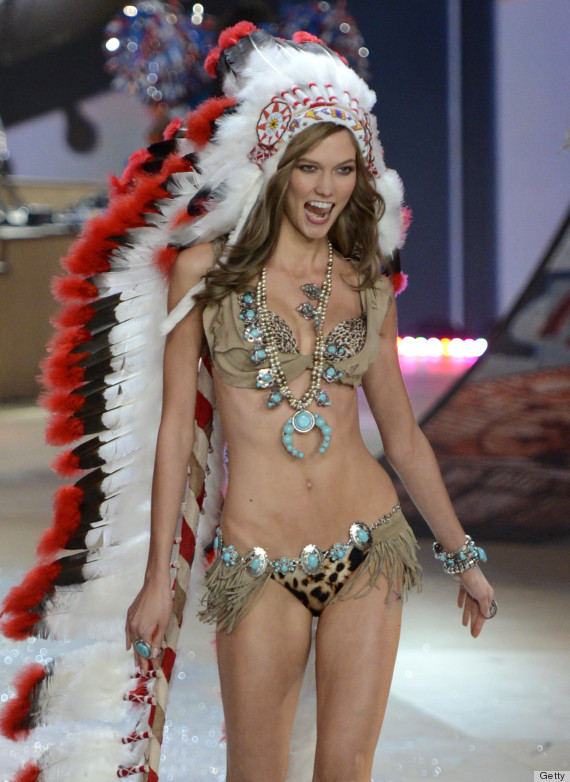
I'm sure, for instance, that many of you would have seen photos from 2012 when a Victoria's Secret model appeared on the runway in a bikini, turquoise jewellery, and a Plains First Nations headdress that stretched all the way down to the floor.

The famous (or infamous?) Victoria's Secret Fashion Show ensemble (c. Getty Images, photographer uncredited)
Immediately, there was an outcry that the use of a Plains First Nations feathered headdress (wapaha) was racist and disrespectful to First Nations people. I have found several reasons cited for this:

1. The wapaha is a sacred object for Plains First Nations peoples, worn only by distinguished tribe and band members who had earned the privilege through service to their communities. Historically, it was the equivalent of a WWI or WWII war medal today. (On a side note: the vast majority of the time, the wapaha is, in fact, worn by men, but since there are First Nations communities where women could act as chiefs, I dare not say that is an absolute rule.)

A genuine First Nations headdress, for the sake of comparison: Sitting Bull's wapaha in the collections of the Royal Ontario Museum, Toronto, Canada (Photo by Kita Inoru)
2. In a day and age when many First Nations women have been victims of sexual harassment and assault and many cases still go unreported, unsolved, etc., it is tasteless to show a fashion ensemble that combines something inherently sexy (a Victoria's Secret bikini) with elements of First Nations cultures.

3. It perpetuates a historical stereotype of First Nations peoples as subservient (particularly sexually) to European colonizers and their descendents. It also promotes a stereotypical conception of the First Nations as stuck in a historical mode of dress (refer back to my "Noble Savage" posts for more).

While the middle argument would be specific to instances where non-First Nations people wear the wapaha while in somewhat compromising positions (ex. photo shoots where models wear the wapaha while wearing little clothing - if any), the first and last also appear in instances when people wear First Nations headdresses simply as fashion accessories. For example, the same outcry happens when images surface of partygoers dressed up as "Native Americans" for Halloween or young people attending indie music and film festivals wearing miniaturized versions of the wapaha. I have also seen the same for First Nations designs making it into "tribal" or "ethnic" clothing sold in major chain stores, dreamcatchers showing up in "inappropriate" places (ex. as bellybutton piercings), etc.

(Note: I don't want to point fingers at any individual people here, so if you really want to know, Google it - I'm not showing pics!)

The main reason why cultural appropriation can cause offense is that it speaks directly into a power dynamic. Historically - and, arguably, even nowadays - First Nations peoples have been marginalized by the very societies and lands they call home. They have endured centuries of being pushed aside, both literally (ex. being forced off their ancestral lands to make way for European immigrants) and figuratively (ex. having elements of their traditional practices - language, religious ceremonies, social customs, etc. - banned in order to force them to assimilate into Euro-American culture). For many First Nations people, then, for whom the scars are still very recent and fresh, the appropriation of their sacred symbols and designs feels like the final straw: "You've taken our people's land, you've forbidden our ancestors from practicing their cultures such that we now have to fight an uphill battle just to learn them, and now you want to just treat what little we have left as an "exotic" fashion trend? No - not gonna happen!"

Personally, I think that any anger and resentment that is felt by First Nations people is justified. However, as someone who is "outside" of the debate, so to speak, and simply an observer, I do think that both parties - the offending and the offended - have some things to learn if this is to be resolved in a positive manner. Again, these are solely my own opinions, but here are some tips that I hope will be helpful in the long run.

Personally, I am someone who would rather give people the benefit of the doubt whenever possible. While there are definitely instances where appropriators are deliberately offensive (either to make a racist statement, or just to be trolls taking advantage of controversy for the sake of publicity), I am of the opinion that there are still many cases where no offense was actually intended.

Now, I know some people say that intention shouldn't factor in here - that appropriation is always racist, plain and simple. But I disagree. Imagine, if you will, that you were approached by a complete stranger who said that something you were doing was "racist" - would you know what you did wrong, and why it was wrong? Not necessarily, I reckon. This is where we come back to my previous discussions on the "Noble" element of the "Noble Savage" myth: "But...but how am I disrespecting you? I think First Nations culture is great, and your art is beautiful - how can I possibly be racist for trying to show my appreciation?"

So, let us say that that's you. You really DO care about First Nations peoples and their cultures, and you are drawn to their aesthetics and want to show that somehow. What can you do?

Three words: Do your homework.

The way I see it, if you love a people and its culture, taking the time to learn more about them should be an enjoyable situation. In today's day and age, with the ready availability of resources out there on the Internet, it's not all that hard to research what is considered "okay" by First Nations people re: the use of their art and culture and what is not. For example, there are websites like Beyond Buckskin, that offer blog posts and articles laying out what sort of First Nations fashion design is acceptable and what is offensive. Actually, that is one that I particularly recommend, because it also features a directory of First Nations artists and designers who produce clothing, accessories, etc. that is both visually appealing and culturally sensitive.


Anishnawbek porcupine quillwork boxes featuring Mickey Mouse and the logo from Canada's 1967 Centennial celebrations, now in the collections of the Royal Ontario Museum, Toronto, Ontario. I do not know if these pieces was made for sale to a non-First Nations market, but if so, they would be the type of thing that is okay to buy and display, since it was made by a First Nations artist aware of their culture. (Photos by Kita Inoru)
Another option, if you are so blessed, is to talk your choices through with someone who is of First Nations descent. Now, I will say very frankly that this is a bit of a risky endeavour. Remember: there is no singular "First Nations" voice or identity: everyone is an individual. What that means is that what's okay with one person may not be to another.

So what if you happen to be in a situation like that and are called out for cultural appropriation? Here are some things you can do:

1. Take it graciously as a further opportunity to learn - getting defensive only belittles the person who is calling you out. Apologize for any offense you might have caused, and ask sincerely how you can do better. Again, if you do actually want to honour First Nations peoples and their cultures, I don't think anyone will fault you for that - it's all a matter of how you do it, so take the chance now to find out.

2. It's not just a matter of freedom of expression. Yes, if you choose to use this as your defence, I daresay that no-one could really rebut that. But here's a saying that I think will help: everything is possible, but not everything is beneficial. Remember, you are under no obligation TO appropriate something from another culture - no one's forcing you at gunpoint to wear a wapaha to Coachella. Freedom of expression is not simply about doing or saying whatever you want - it's also about learning how to utilize and exercise that freedom in a way that is actually constructive to others. So if you know that something is going to be offensive, why do it?

3. Because cultural appropriation implies a asymmetrical power dynamic, not every instance of borrowing really counts. This is in response to one argument I've seen: "If I can't wear a headdress, then you can't wear jeans and a T-shirt either. That's you appropriating my culture!" Unfortunately, it doesn't work that way. Why? A) because wearing jeans and a T-shirt is not perpetuating a caricature or stereotype (it's so common around the world now to be practically neutral); and B) if it is, it's one that reflects the same Eurocentric hegemony that makes the appropriation of First Nations cultures offensive in the first place.

Finally, I do want to give a quick word to those who have been the offended party in this. I've seen many cases, especially on Pinterest, where it feels almost like people are talking behind each other's backs: posting images of appropriation and making very angry (and very profane) comments. Now, this may be just me, but it does come across as rather petty at times - and also sparks the offender into the natural human response of getting defensive rather than calming down and listening.

This is why my biggest tip for people who are First Nations or who care about First Nations issues is to encourage you to offer counterexamples. Don't just say to someone, "What you're doing is offensive and racist," but offer an example of what CAN be done instead.

Again, as far as I'm concerned, it's all about creating a positive learning environment for all parties, so that those of us out there who aren't First Nations can truly honour those of us who are.

Sources

Young, James O. “Profound Offense and Cultural Appropriation.” The Journal of Aesthetics and Art Criticism. 63.2 (2005): 135-146. Print. 
Image Credits
All images (c) their original creators, as indicated (if known) in the captions